Modulr Slider
Three oscillators, a ring modulator and a spring reverb, every control a slider over a patch bay of live cables.
Modulr Slider is a semi-modular synthesizer after the grammar of the ARP 2600 (ARP, 1971): three oscillators, a noise generator with sample and hold, a ring modulator, a four-pole filter, an amplifier, an ADSR and an AR envelope, and a spring reverb, every control a vertical slider in a long row over a patch bay. Fifty-one jacks are live: the cords the drawing seeds are the patch it opens with, and you click two jacks to patch and double-click a jack to unplug. It is a VST3 and Audio Unit plug-in with a mono voice.
Five sounds, played as they ship.
Each clip is the plug-in itself: a patch is picked in the drawer and loaded, then a played chord or line sounds on it, the way it is played into the plug-in from a keyboard, through the cables the drawing seeds. The bank holds twenty-three patches of twenty-three distinct tones; these are five of them. No effects added, no mastering.
A semi-modular, with the cables live.
- Three oscillators.Two audio oscillators and a third that runs slow or at audio rate; the second can sync to the first, and the third can modulate the first’s pulse width or pitch.
- Noise and sample and hold, and a ring modulator.A noise generator with a sample and hold, and a ring modulator that multiplies two sources; each is a module with its own jacks, silent until it is patched somewhere.
- A filter and an amplifier.A four-pole filter and an amplifier, with a preamp and the output after them; the filter takes control voltages on its own jacks.
- Two envelopes.An ADSR and an AR; the ADSR opens the amplifier and the filter’s envelope slider by default, and the AR sits on the filter’s first control input in the drawn patch.
- The patch bay.Fifty-one jacks in the groups the drawing gives them. The seven drawn cords are the patch it opens with: no audio is wired behind the scenes, so unplugging the oscillator’s cord into the filter gives silence, and plugging it back restores the sound. Click an output and then an input to add a cord; double-click a jack to remove its cord.
- A spring reverb.The reverb is the spring tank ported from Modulr Tension’s spring: touch the drawn springs and they ring, and the tank rings with them in the sound.
- Patches that load the whole panel.Pick a patch and every slider and switch moves to it at once; the drawer closes and the keys are ready. A patch sets the tone only and leaves your cables as they are. Hold to preview plays a patch’s tone on your own MIDI, and when you let go the instrument is put back.
- One voice.The voice is mono: a held chord plays one note. The balance and stereo switches are drawn and do nothing.
What it needs.
| Format | Systems | Licence |
|---|---|---|
| VST3 · Audio Unit | macOS 11 or later, on Apple silicon | A licence is needed to make sound. Without one the editor opens and the output is silent. |
The editor, and the module it becomes.
The plug-in is built. The Eurorack module drawn beside it, with its macro sliders and the control jacks under them, is a design study and is not.
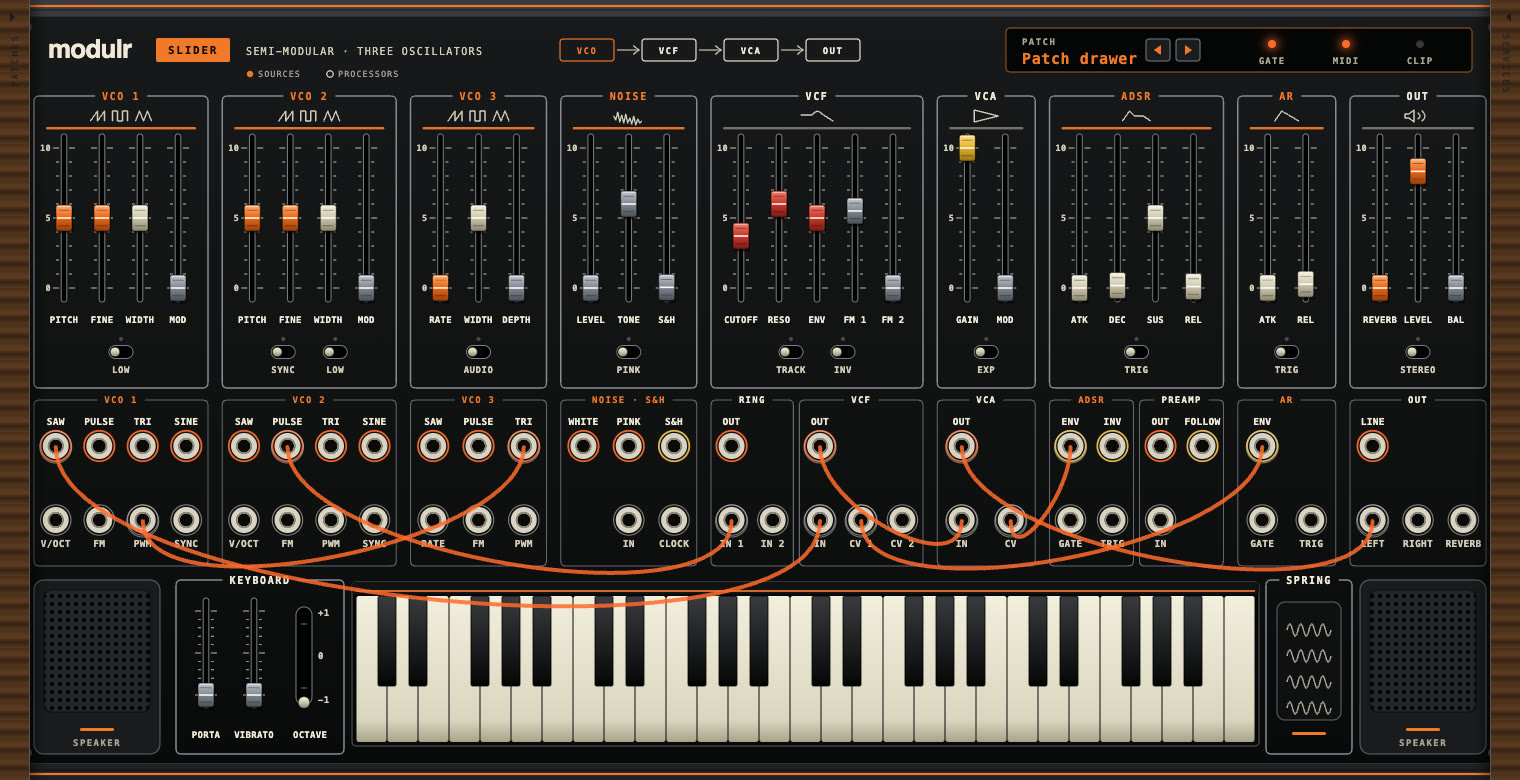
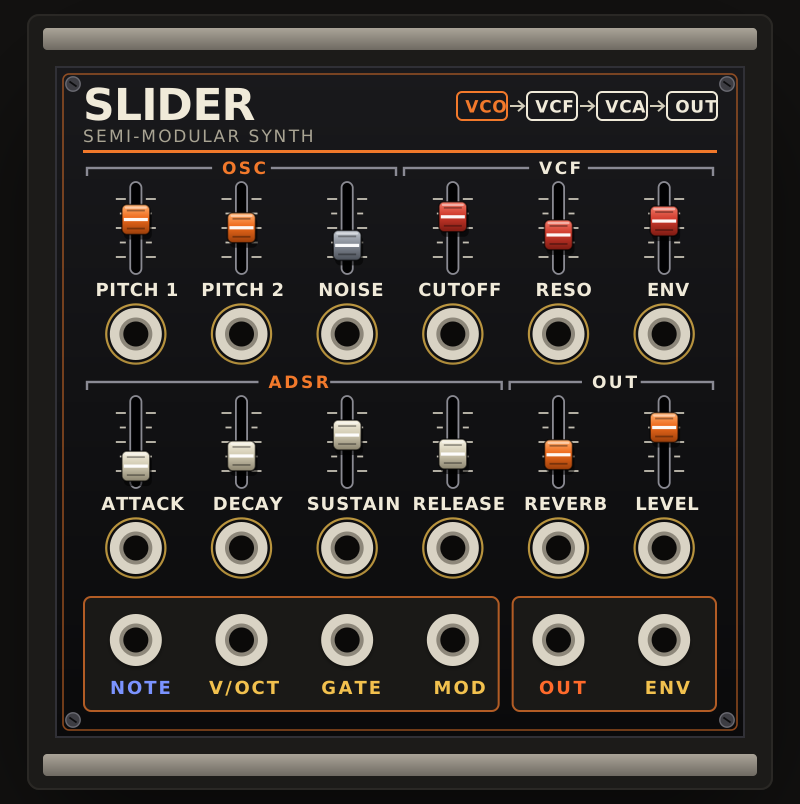
The editor is the plug-in’s own, playing a patch. The module is drawn by the specification’s own kit, and its values are illustrative, not measured. The design is the ARP 2600’s grammar, redrawn in Modulr’s own words, and nothing on it is measured against the instrument.
ARP 2600, 1971.
The instrument’s own grammar, as the catalogue recalls it: the sections, the controls and the look the study borrows.
The slider grammar of a semi-modular: every control is a vertical slider in a long row grouped by module (oscillators, filter, envelopes, output), a patch bay of jacks under it grouped the same way, patch cords, a keyboard and a speaker.
A black panel in an orange keyline with white and orange lettering: twelve vertical sliders with coloured caps and short printed scales in four boxed sections (orange titles for sources, white for processors), a CV jack under each, and the jacks in two dark trays with orange and yellow rings.
- Three VCOs
- A noise generator
- A ring modulator
- A VCF and a VCA
- An ADSR and an AR envelope
- An LFO (and sample and hold)
- A preamp and a spring reverb
- A patch matrix of jacks across the bottom with patch cords
The module, knob by knob.
The macros are the signature controls a player reaches for, not a generic set; each one has a control jack under it on the module.
| Macro | Key | Range | Default |
|---|---|---|---|
| Pitch 1 | vco1.pitch | ±24 st | 0 st |
| Pitch 2 | vco2.pitch | ±24 st | 0 st |
| Noise | noise.level | 0–100% | 0% |
| Cutoff | vcf.cut | 20 Hz – 20 kHz | 20 kHz |
| Reso | vcf.res | 0–100% | 0% |
| Env | vcf.env | 0–100% | 0% |
| Attack | adsr.atk | 0 ms – 20 s | 5 ms |
| Decay | adsr.dec | 0 ms – 20 s | 300 ms |
| Sustain | adsr.sus | 0–100% | 70% |
| Release | adsr.rel | 0 ms – 20 s | 300 ms |
| Reverb | out.verb | 0–100% | 0% |
| Level | out.level | -inf – +6 dB | 0.0 dB |
| Side | Jacks |
|---|---|
| In | Note (MIDI), V/Oct (CV), Gate (CV), Mod (CV) |
| Out | Out (Audio), Env (CV) |
Legendary is the catalogue of the Modulr Synths project: 43 design studies drawn with the specification’s own kit, 33 after the synthesizers of all time and 10 after the drum machines. The makers and years named here are the instrument’s; the names, the layouts and every value are Modulr’s own.