Modulr Plate
A touch-plate rack you can patch: five panels, forty-four live sockets and fifty-three controls, with eleven patches.
Modulr Plate is a synthesizer after the grammar of a 1963 touch-plate modular, drawn as a rack of five panels: pressure plates that give a fixed rank of voltages, a stepped voltage source with step lights, a dual envelope and gate, a dual oscillator and a dual lowpass gate, and sockets coloured by signal type. As a plug-in it is the rack itself, patched: it opens as a voice you play from MIDI (a key presses a plate, the plate’s gate opens envelope A, envelope A opens lowpass gate A, and oscillator A runs through it to the speaker), and every cord can be moved.
Five sounds, played as they ship.
Each clip is the plug-in itself: a patch is picked in the drawer and loaded, then a short phrase is played on it, through the patch the panel opens with (the keys into oscillator A, through lowpass gate A, which envelope A opens). The eleven patches hold five distinct sounds, one for each clip here. No source documents a setting on the instrument these records were made on, so the artist-named patches are this product’s reading of a sound’s role, not the artist’s own.
A rack, patched.
- Touch.Six plates over six voltage knobs. A key you play presses the plate its semitone names (the six repeat from middle C), and each plate’s pad presses it by hand; sockets carry each plate’s voltage, their sum, the pressure, a gate and a pulse, with a hold and a glide.
- Gate.Two envelopes, each a rise and a fall, with a gate in and the envelope out.
- Step.Three rows of six voltages, stepped by your host’s transport or by a cord at the clock socket, with a tempo; a row out to an oscillator’s pitch socket plays a melody.
- Tone.Two oscillators, each with a frequency, a fine tune, a frequency modulation depth, a symmetry and a timbre selector from sine to pulse; sine and saw sockets.
- Pass.Two lowpass gates: a control voltage opens the level and the cutoff together, so a gate with nothing patched to it is closed.
- The patch it opens in.The keys into oscillator A, through lowpass gate A that envelope A opens, to the speaker, with a level knob. Move a cord and the rack answers; the second channel is patched the same way.
- What is drawn and does nothing.The envelopes’ on time, manual gate and mode, the oscillators’ range, the gates’ mode and response, the sequence length, mode and step keys, and thirteen sockets (the pulse and rise inputs, the run and skip inputs, the sum and the six stage pulses) have no module in the kernel: they are drawn, and a cord to one of the sockets is refused.
- Patches that load the whole sound.Pick a patch and every control moves to it at once; the drawer closes and the keys are ready. Hold to preview plays a patch’s tone on your own MIDI, and when you let go the instrument is exactly as it was.
- Services.Choose whether the instrument answers your host’s MIDI and clock, set its output level, and age it.
What it needs.
| Format | Systems | Licence |
|---|---|---|
| VST3 · Audio Unit | macOS 11 or later, on Apple silicon | A licence is needed to make sound. Without one the editor opens and the output is silent. |
The editor, and the module it becomes.
The plug-in is built. The Eurorack module is drawn, with its macro knobs and the control jacks under them, and is not.
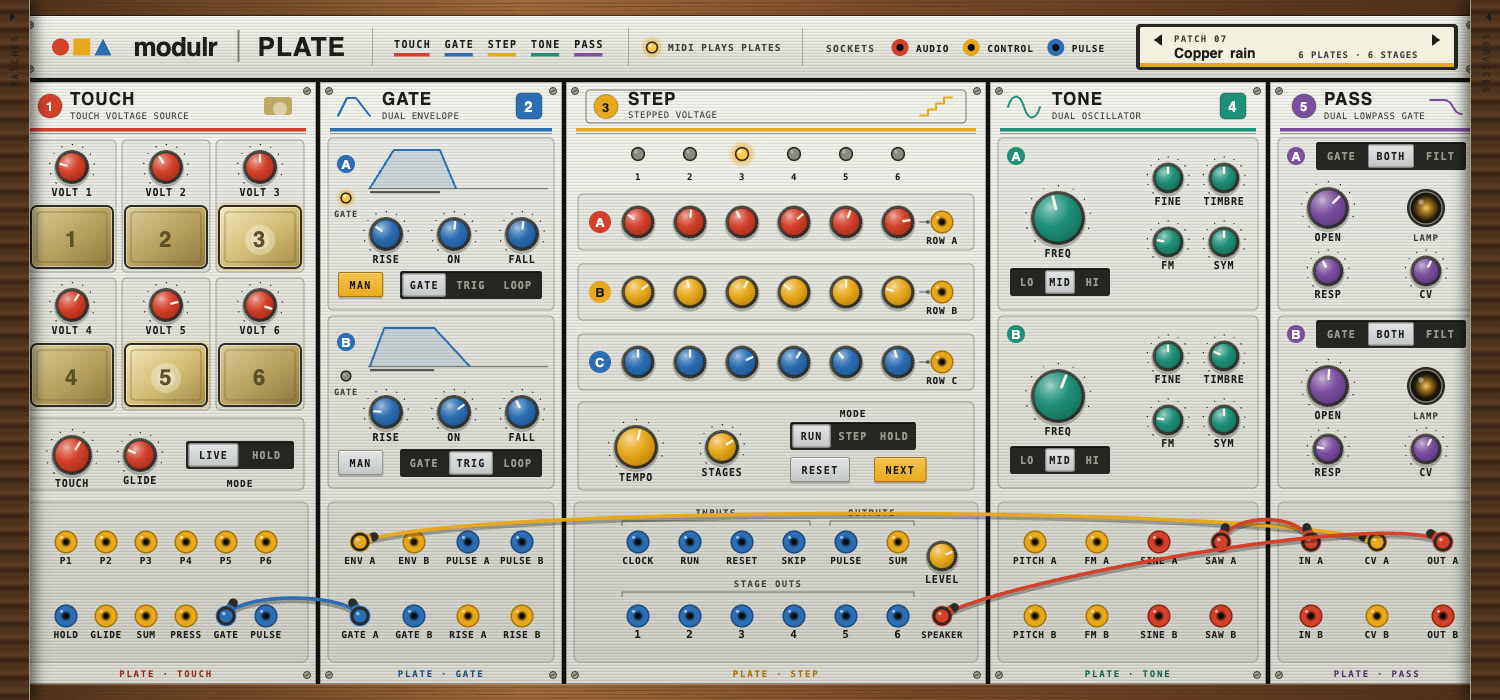
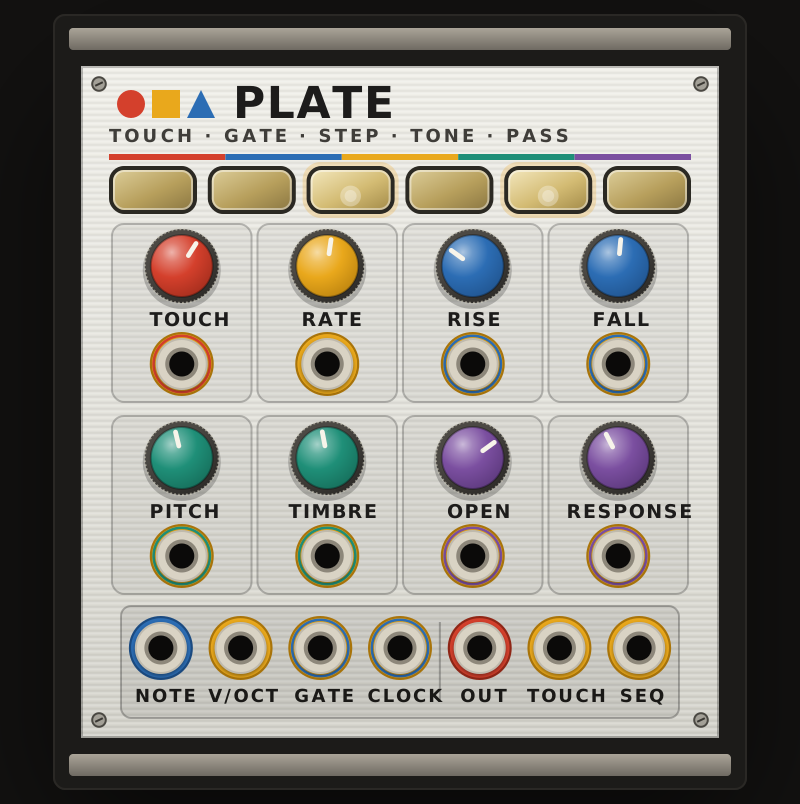
The editor is the plug-in’s own, as it opens; its patch card shows the drawing’s own “Copper rain” whatever patch is loaded. The module is drawn by the specification’s own kit, and its values are illustrative, not measured. The design is the Buchla 100 series’ grammar, redrawn in Modulr’s own words, and nothing on it is measured against the instrument.
Buchla 100 series, 1963.
The instrument’s own grammar, as the catalogue recalls it: the sections, the controls and the look the study borrows.
The touch-plate modular grammar: pressure plates that give a fixed rank of voltages, a sequencer of knob rows over stage lamps, a dual envelope and gate, a dual oscillator and a dual lowpass gate, patched with coloured sockets by signal type.
A satin-white panel in 24 HP with a rule of five section colours, a strip of six brass touch plates, eight small coloured knobs each with its CV socket under it in a recessed cell, and a bay of coloured banana-style sockets.
- A touch-controlled voltage source: pressure plates giving a fixed rank of stable voltages
- A dual envelope and gate
- A sequential voltage source: rows of knobs with step lights
- A dual oscillator
- A dual lowpass gate
- Banana jacks in several colours, patched with short cords
- No keyboard
The module, knob by knob.
The module is a design study and is not built. Its macros are the signature controls a player reaches for, not a generic set; each one has a control jack under it.
| Macro | Key | Range | Default |
|---|---|---|---|
| Touch | tch.sens | 0–100% | 50% |
| Rate | seq.rate | 0.1 – 40 Hz | 2 Hz |
| Rise | env.rise | 1 ms – 10 s | 10 ms |
| Fall | env.fall | 1 ms – 10 s | 300 ms |
| Pitch | osc.freq | 16 Hz – 8 kHz | 262 Hz |
| Timbre | osc.timbre | 0–100% | 0% |
| Open | lpg.open | 0–100% | 50% |
| Response | lpg.resp | 5 ms – 2 s | 150 ms |
| Side | Jacks |
|---|---|
| In | Note (MIDI), V/Oct (CV), Gate (CV), Clock (CV) |
| Out | Out (Audio), Touch (CV), Seq (CV) |
Legendary is the catalogue of the Modulr Synths project: 43 design studies drawn with the specification’s own kit, 33 after the synthesizers of all time and 10 after the drum machines. The makers and years named here are the instrument’s; the names, the layouts and every value are Modulr’s own.