Modulr Cabinet
A cabinet of numbered modules: oscillators, a filter bank, amplifiers, envelopes, a sequencer and a ring modulator, patched by hand.
Modulr Cabinet is a design study after a wooden-cabinet modular of 1965: numbered black modules in ruled boxes, one knob and one jack per job, and cords patched between silver jacks.
The editor, and the module it becomes.
Each study is drawn twice: as a standalone plug-in editor, and as a Eurorack module with its macro knobs and the control jacks under them. Nothing here is built.
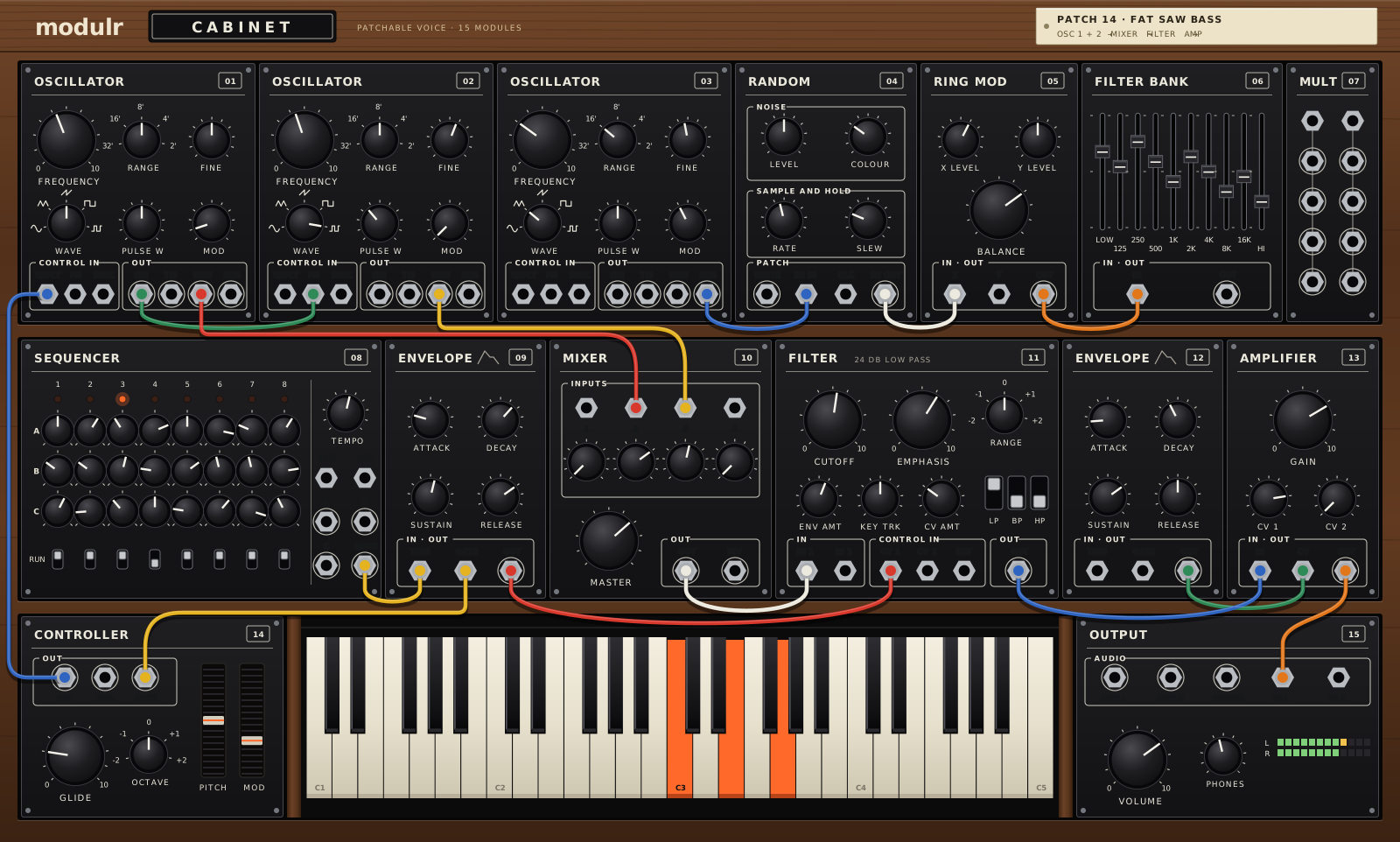
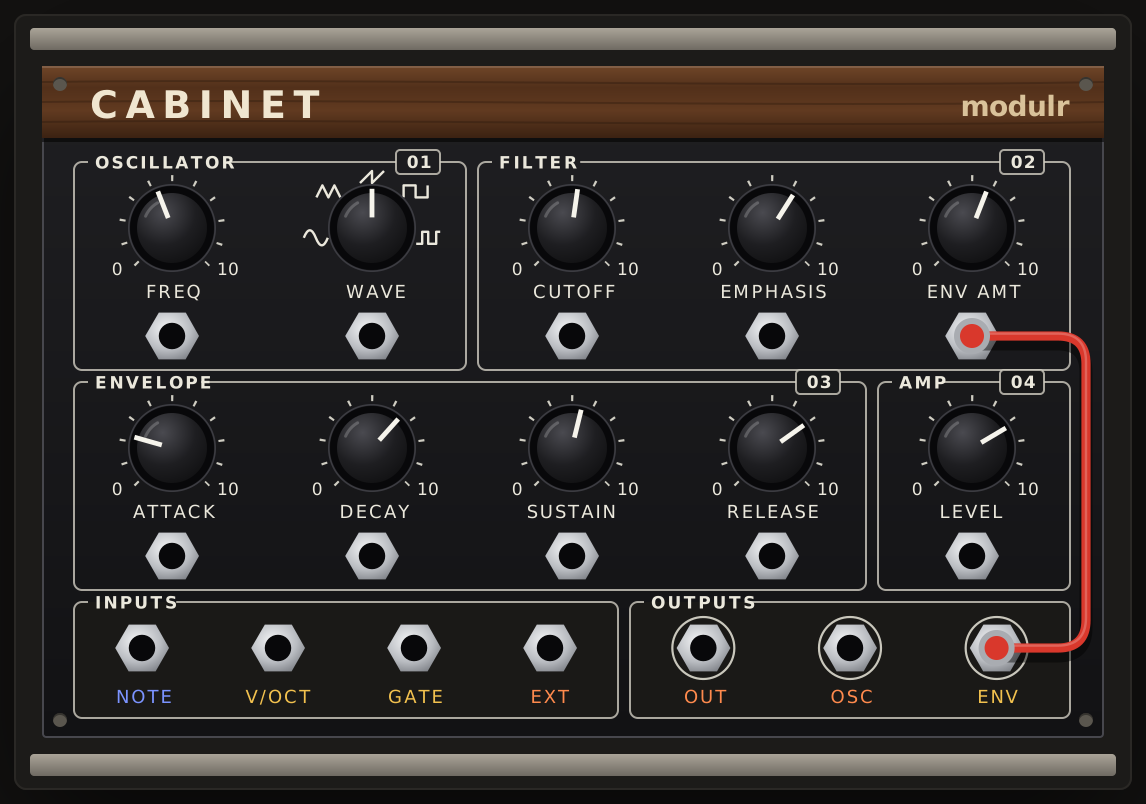
Mock UI — drawn by the specification’s own kit, not a screenshot of a shipped editor. Values are illustrative, not measured. The study is Moog modular’s grammar, redrawn in Modulr’s own words, and nothing on it is measured against the instrument.
Moog modular, 1965.
The instrument’s own grammar, as the catalogue recalls it: the sections, the controls and the look the study borrows.
The cabinet grammar: numbered black modules in ruled boxes, one knob and one jack per job, a 24 dB low-pass filter with emphasis, an attack, decay, sustain and release envelope, and patch cords between silver jacks.
A walnut rail over a matte black panel with white engraved, numbered boxes: oscillator, filter, envelope and amplifier, ten big black skirted knobs with a printed scale and a white line, a CV jack under each, on silver hex jacks.
- A cabinet of numbered modules in rows, with banks of jacks and patch cords in several colours
- Oscillators with frequency and range knobs and waveform outputs
- A 24 dB ladder filter with a fixed filter bank, and a mixer
- Voltage-controlled amplifiers
- Envelope generators (attack, decay, sustain and release)
- A sequencer, and a ring modulator
- Noise and sample and hold
- A controller keyboard below
The module, knob by knob.
The macros are the signature controls a player reaches for, not a generic set; each one has a control jack under it on the module.
| Macro | Key | Range | Default |
|---|---|---|---|
| Freq | osc.freq | 16 Hz – 8 kHz | 261.6 Hz |
| Wave | osc.wave | Sine / Tri / Saw / Square / Pulse | Saw |
| Cutoff | vcf.cut | 20 Hz – 20 kHz | 20 kHz |
| Emphasis | vcf.emph | 0–100% | 0% |
| Env amt | vcf.env | 0–100% | 0% |
| Attack | env.att | 1 ms – 10 s | 5 ms |
| Decay | env.dec | 1 ms – 10 s | 300 ms |
| Sustain | env.sus | 0–100% | 70% |
| Release | env.rel | 1 ms – 10 s | 300 ms |
| Level | vca.gain | -inf – +6 dB | 0 dB |
| Side | Jacks |
|---|---|
| In | Note (MIDI), V/Oct (CV), Gate (CV), Ext (Audio) |
| Out | Out (Audio), Osc (Audio), Env (CV) |
Legendary is the catalogue of the Modulr Synths project: 43 design studies drawn with the specification’s own kit, 33 after the synthesizers of all time and 10 after the drum machines. The makers and years named here are the instrument’s; the names, the layouts and every value are Modulr’s own.