Modulr Pin
A pin matrix of sixteen by sixteen sockets, three oscillators, a ring modulator and a joystick, as a plug-in.
Modulr Pin is a synthesizer after the grammar of the 1969 VCS 3: a pin in a socket joins a source to a destination in place of a cable. Two oscillators of sine, ramp and pulse, a slow third, noise, a ring modulator, a resonant filter, an attack, on, decay and off envelope shaper with a repeat, a reverb and a joystick, patched through 256 sockets with pins in four colours. Fifty patches that each load every control and pin. VST3 and Audio Unit.
Eight patches, rendered by the plug-in.
Each clip is the plug-in’s own DSP rendered offline, not a recording made in a DAW: a patch is loaded, a short phrase is played on it, and the take is set to the picture of the editor. The fifty patches are the plug-in’s own settings. Their levels and spectra were measured; they were not auditioned against any instrument or artist, so nothing here claims one sounds like another. These are eight of the fifty.
A patch-pin synthesizer, played from your keyboard.
- A pin matrix of 256 sockets.Sixteen sources by sixteen destinations. A pin joins one to the other, and its colour (white, green, red or blue) sets how much passes.
- Three oscillators.Two with sine, ramp and pulse, and a slow third for modulation.
- Noise and a ring modulator.Both are sources in the matrix like the oscillators.
- A resonant filter.Cutoff and response, and the filter can be patched as a sound source of its own.
- An envelope shaper.Attack, on, decay and off, with a repeat, drawn as a trapezoid.
- A reverb and a joystick.The joystick’s two axes are sources you can pin anywhere; the output has a tone and a centre control.
- Fifty patches.Each loads every control and every pin at once.
What it needs.
| Format | Systems | Licence |
|---|---|---|
| VST3 · Audio Unit | Apple silicon, macOS 11 or later | $25. A licence file for each machine is needed to make sound, and there is no automatic way yet for a customer to receive one: a downloaded copy stays silent until it is licensed. |
| Signing | Ad hoc signed and not notarized, so macOS Gatekeeper will warn before it opens. | |
The editor, and the module it becomes.
The plug-in is built, and its editor is shown as it opens. The Eurorack module is drawn beside it, and the module is not built.
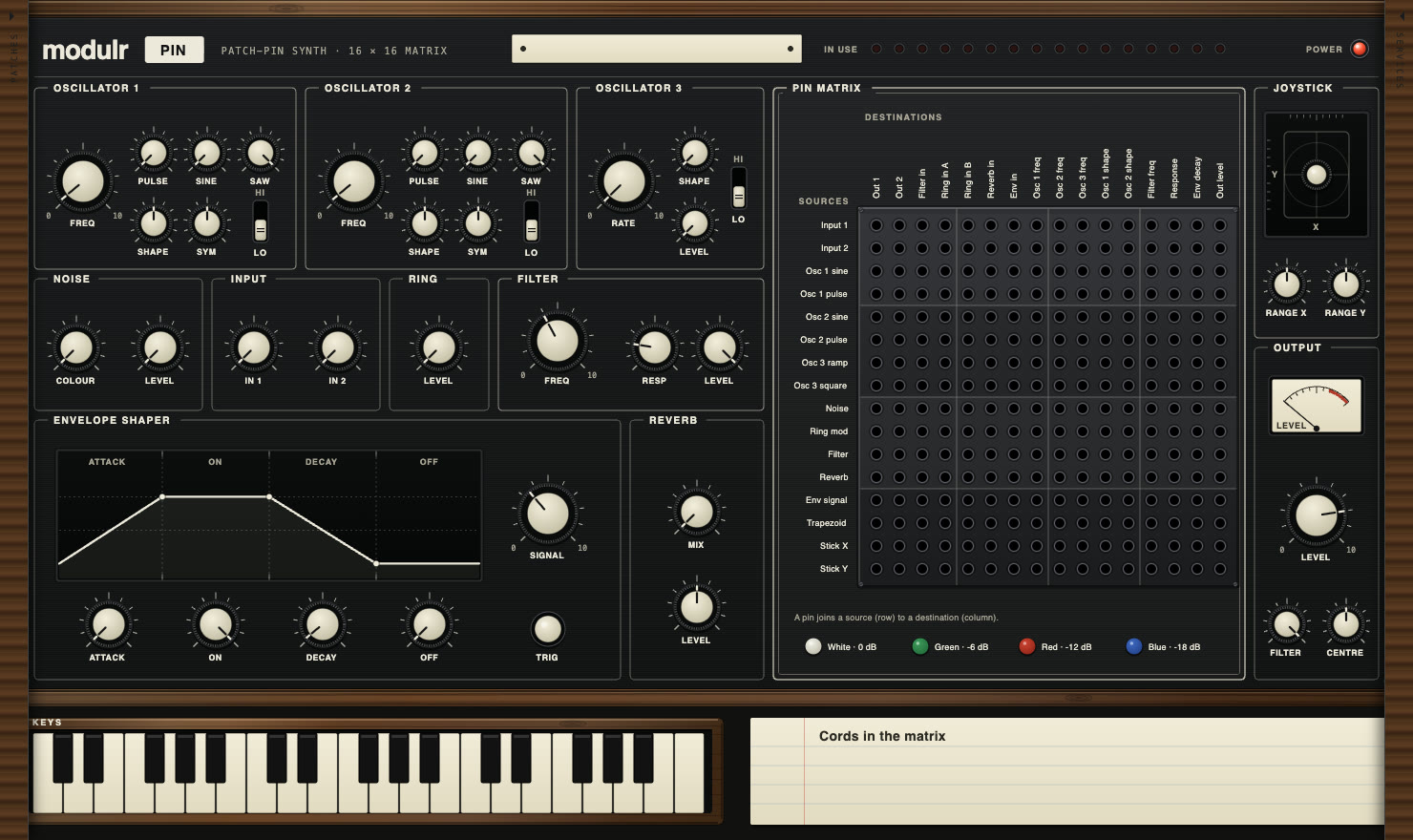
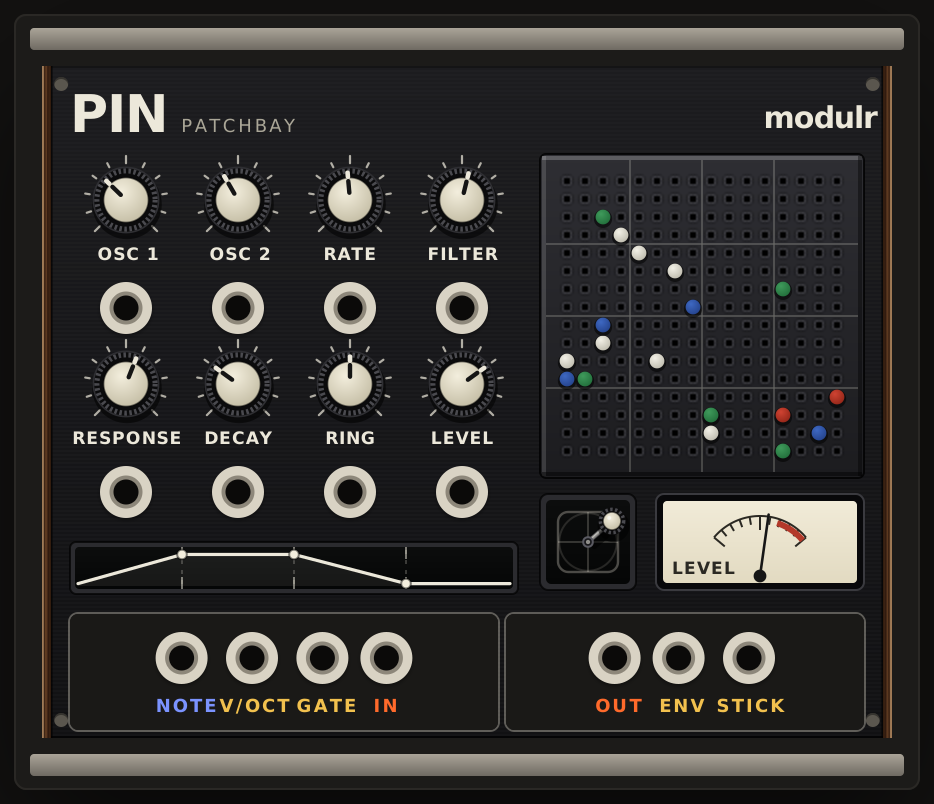
The editor is the plug-in’s own, as it opens. The module is drawn by the specification’s own kit, and its values are illustrative, not measured. The design is VCS 3’s grammar, redrawn in Modulr’s own words, and nothing on it is measured against the instrument.
VCS 3, 1969.
The instrument’s own grammar, as the catalogue recalls it: the sections, the controls and the look the study borrows.
The patchbay grammar: every source reaches every destination through a square of pin holes instead of cables, with three oscillators, noise, a ring modulator, a filter, a reverb, an attack, on, decay, off envelope drawn as a trapezoid, a joystick, and a keyboard kept apart.
A black anodised panel between two teak cheeks, with fluted black knobs with cream caps and a printed dial, a small 16 by 16 pin matrix with white, green, red and blue pins, a joystick well, a level meter and a trapezoid window, and the jacks in a dark tray.
- A sixteen by sixteen pin matrix patchbay, each pin joins a source to a destination
- Three oscillators: two audio and one low-frequency, with shape and level knobs
- Noise
- Ring modulator
- An input amplifier
- A filter and oscillator
- A reverb
- An envelope shaper with attack, on, decay and off
The module, knob by knob.
The module is a design study and is not built. Its macros are the signature controls a player reaches for, not a generic set; each one has a control jack under it.
| Macro | Key | Range | Default |
|---|---|---|---|
| Osc 1 | osc1.freq | 20 Hz – 20 kHz | 262 Hz |
| Osc 2 | osc2.freq | 20 Hz – 20 kHz | 262 Hz |
| Rate | osc3.rate | 0.05 – 500 Hz | 1.0 Hz |
| Filter | vcf.freq | 20 Hz – 20 kHz | 20 kHz |
| Response | vcf.res | 0–10 | 0.0 |
| Decay | env.decay | 1 ms – 20 s | 500 ms |
| Ring | ring.level | 0–10 | 0.0 |
| Level | out.level | 0–10 | 5.0 |
| Side | Jacks |
|---|---|
| In | Note (MIDI), V/Oct (CV), Gate (CV), In (Audio) |
| Out | Out (Audio), Env (CV), Stick (CV) |
Legendary is the catalogue of the Modulr Synths project: 43 design studies drawn with the specification’s own kit, 33 after the synthesizers of all time and 10 after the drum machines. The makers and years named here are the instrument’s; the names, the layouts and every value are Modulr’s own.