Modulr Split
Six voices, a keyboard split in two, and a panel of sliders with a bank of patch buttons.
Modulr Split is a design study after the grammar of the 1981 Polysix: two oscillators, a mixer with noise, a resonant filter, one ADSR envelope, an LFO, portamento, and a keyboard that splits in two so one sound can be layered over the other.
The editor, and the module it becomes.
Each study is drawn twice: as a standalone plug-in editor, and as a Eurorack module with its macro knobs and the control jacks under them. Nothing here is built.
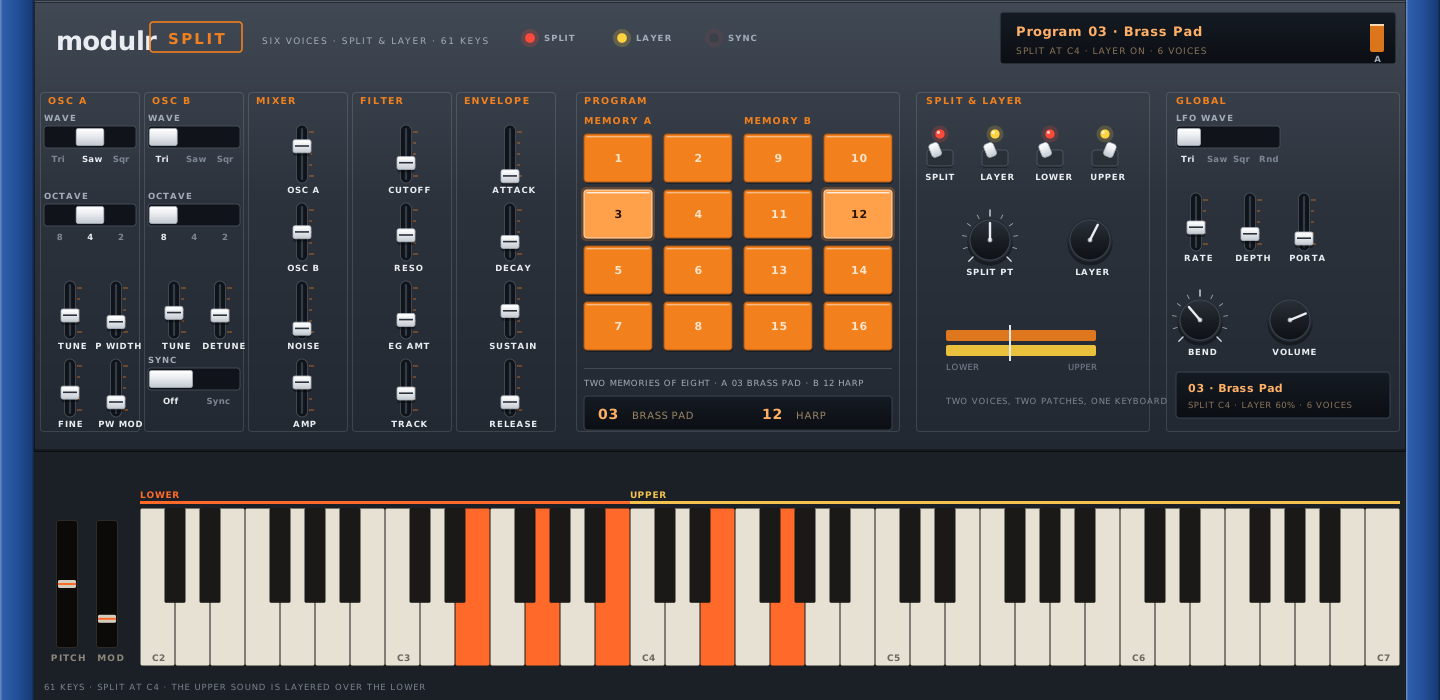
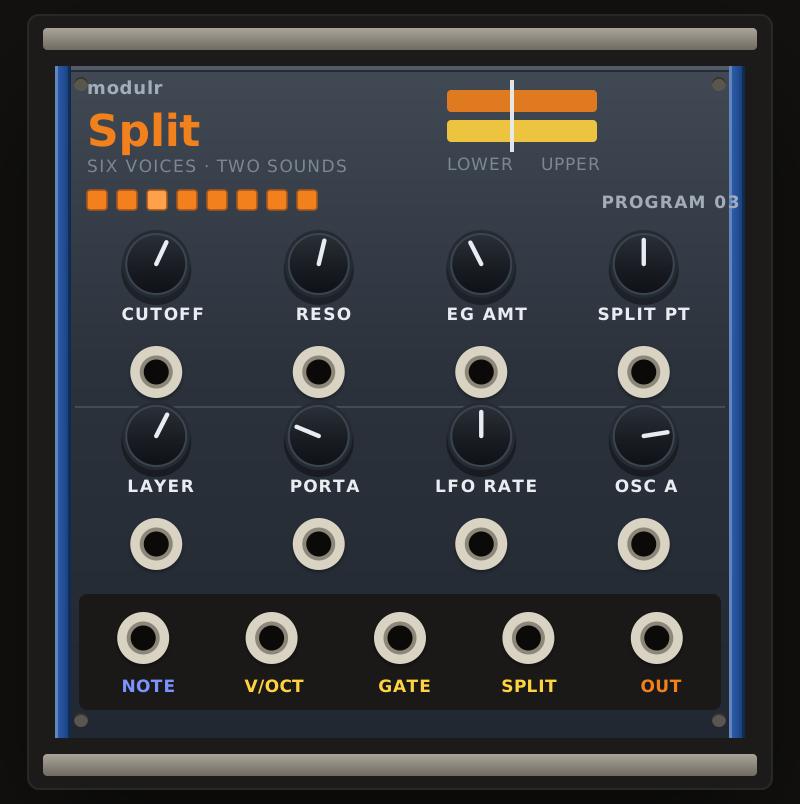
Mock UI — drawn by the specification’s own kit, not a screenshot of a shipped editor. Values are illustrative, not measured. The study is Polysix’s grammar, redrawn in Modulr’s own words, and nothing on it is measured against the instrument.
Polysix, 1981.
The instrument’s own grammar, as the catalogue recalls it: the sections, the controls and the look the study borrows.
The split polysynth grammar: two oscillators with octave, waveform and tune, a mixer with a noise source, a resonant filter with an envelope amount, one ADSR envelope, an LFO with a waveform switch, portamento, and a keyboard that splits in two so one sound can be layered over the other.
A 26 HP panel in the character of a 1981 six-voice analogue polysynth: a dark blue-grey sheet printed with white lettering and orange section headings, blue end cheeks, eight black macro knobs with white pointer lines, a bright bank of square program buttons, and the jacks in a dark tray.
- Six voices of two oscillators (octave, waveform, tune) with a mixer and a noise source
- A keyboard split into two halves, each with its own sound, and a layer of one sound over the other
- Two patch memories of eight, chosen with a bank of buttons
- A resonant filter (cutoff, resonance, envelope amount)
- One ADSR envelope
- An LFO with a waveform switch
- Portamento
- A 61-key keyboard
The module, knob by knob.
The macros are the signature controls a player reaches for, not a generic set; each one has a control jack under it on the module.
| Macro | Key | Range | Default |
|---|---|---|---|
| Cutoff | vcf.cut | 20 Hz – 20 kHz | 20 kHz |
| Reso | vcf.res | 0–100% | 0% |
| EG Amt | vcf.env | 0–100% | 0% |
| Split Pt | kbd.split | C1 – C6 | C4 |
| Layer | kbd.layer | 0–100% | 0% |
| Porta | kbd.porta | 0 ms – 2 s | 0 ms |
| LFO Rate | lfo.rate | 0.1 – 30 Hz | 5 Hz |
| Osc A | mix.oscA | 0–100% | 70% |
| Side | Jacks |
|---|---|
| In | Note (MIDI), V/Oct (CV), Gate (CV) |
| Out | Split (CV), Out (Audio) |
Legendary is the catalogue of the Modulr Synths project: 43 design studies drawn with the specification’s own kit, 33 after the synthesizers of all time and 10 after the drum machines. The makers and years named here are the instrument’s; the names, the layouts and every value are Modulr’s own.