Modulr Song
Rhythms with their own bass lines, arranged part by part over eleven steps, and written down as songs.
Modulr Song is a design study after a rhythm composer of 1981, drawn as a plug-in editor and as a 26 HP module. It borrows the instrument’s grammar: eleven preset rhythms with their bass lines and chords, a 32-note keyboard carrying the rhythm sounds, part buttons and an eleven-step arrangement.
The editor, and the module it becomes.
Each study is drawn twice: as a standalone plug-in editor, and as a Eurorack module with its macro knobs and the control jacks under them. Nothing here is built.
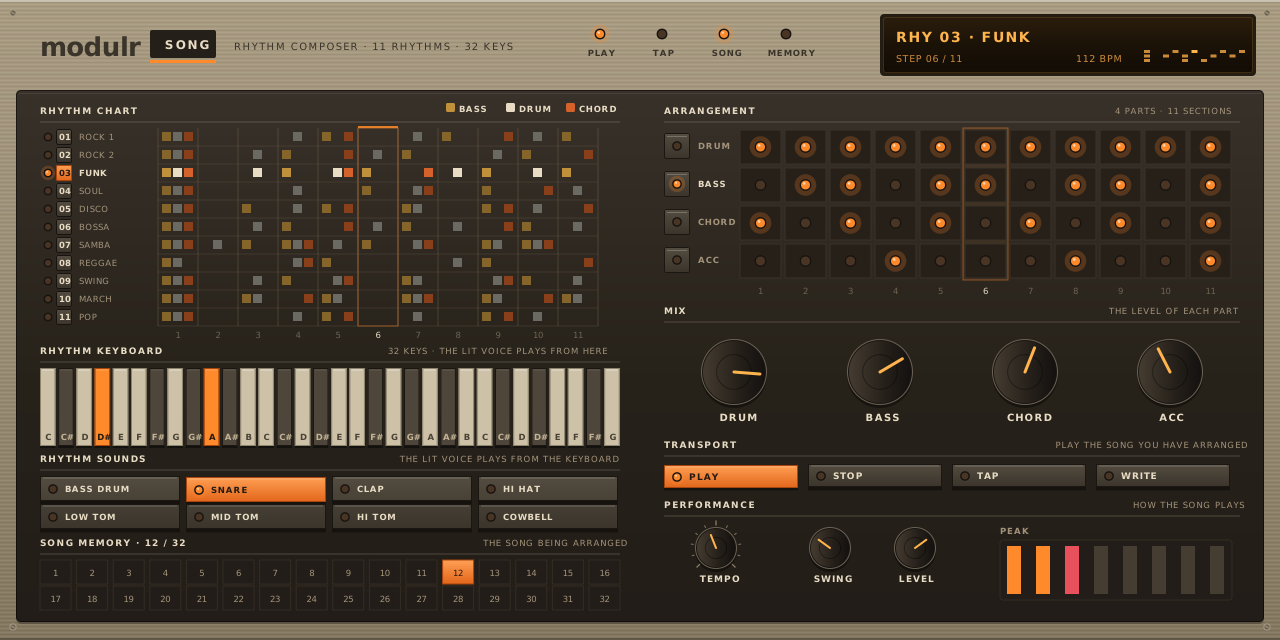
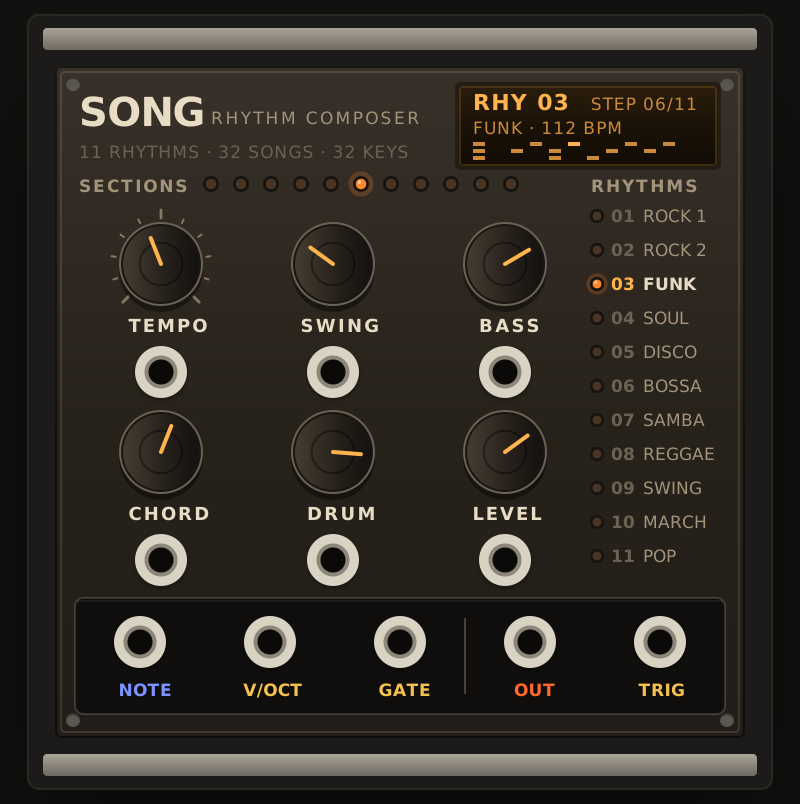
Mock UI — drawn by the specification’s own kit, not a screenshot of a shipped editor. Values are illustrative, not measured. The study is RX-7’s grammar, redrawn in Modulr’s own words, and nothing on it is measured against the instrument.
RX-7, 1981.
The instrument’s own grammar, as the catalogue recalls it: the sections, the controls and the look the study borrows.
The rhythm-composer grammar: eleven printed rhythm charts, a long row of narrow flat keys that carries the sound, square voice pads and part buttons with amber lamps, an eleven-section arrangement, a bank of thirty-two songs, a tempo knob and a small amber display.
A warm charcoal panel in 26 HP: the title in cream, a small amber read-out carrying the loaded rhythm, a row of eleven section lamps, the list of the eleven rhythms down the right, six dark knobs each over its control jack, and the jacks in a dark tray.
- Eleven preset rhythms, each with its own bass line and chord
- A 32-note keyboard carrying the rhythm sounds
- A row of part buttons, so a part can be switched in and out
- An eleven-step, part-by-part arrangement
- A memory of thirty-two songs
- A tempo knob and a display
The module, knob by knob.
The macros are the signature controls a player reaches for, not a generic set; each one has a control jack under it on the module.
| Macro | Key | Range | Default |
|---|---|---|---|
| Tempo | seq.tempo | 40–240 BPM | 120 BPM |
| Swing | seq.swing | 0–70% | 0% |
| Bass | mix.bass | 0–100% | 80% |
| Chord | mix.chord | 0–100% | 70% |
| Drum | mix.drum | 0–100% | 100% |
| Level | out.level | -inf – +6 dB | 0.0 dB |
| Side | Jacks |
|---|---|
| In | Note (MIDI), V/Oct (CV), Gate (CV) |
| Out | Out (Audio), Trig (CV) |
Legendary is the catalogue of the Modulr Synths project: 43 design studies drawn with the specification’s own kit, 33 after the synthesizers of all time and 10 after the drum machines. The makers and years named here are the instrument’s; the names, the layouts and every value are Modulr’s own.