Modulr Click
Sixteen drum buttons, a pattern you click in while it runs, and sixteen patches that each load a whole kit.
Modulr Click is a drum machine after the grammar of a 1983 rhythm composer. Sixteen instrument buttons with their lamps, a wall of level, tune, attack and decay knobs, a shuffle switch, and a sixteen-step sequencer of four lanes that you edit by clicking a square, even while it runs. Sixteen patches, each loading a whole kit and pattern at once, and sixteen memory keys that recall them.
Fifteen patches, played as they ship.
Each clip is the plug-in itself: the patch is picked in the drawer and loaded, and its pattern runs from the Start key. Each patch is Modulr’s own groove for a style, named for what it is; it is not a copy of any record. The sound is the instrument’s own output, with no effects and no mastering.
A drum machine you load, then edit as it runs.
- Buttons that play.Each of the sixteen instrument buttons strikes its voice, and your host’s MIDI notes strike them too, one voice to a note.
- A pattern you click in.Four lanes of sixteen steps: bass drum, snare, closed hat and clap. Click a square to turn a step on or off, while the pattern runs.
- Start, Stop, Continue, Reset.Start runs the pattern at the machine’s tempo. Under your host’s Play it locks to the host’s bar and tempo, or you can turn that off in the services.
- Patches that load the whole kit.Pick a patch and the voices’ knobs, the tempo, the shuffle and the four lanes all move to it at once; the drawer closes and the pattern is ready to run.
- Hold to preview.Hold a key to hear a patch’s kit on your own notes or the drum buttons, then let go and the instrument is exactly as it was.
- Sixteen memories.The sixteen memory keys on the panel recall the sixteen patches.
- Services.Choose whether the instrument answers your host’s MIDI and clock and whether Play runs the pattern, set its output level, and age it: the decay shortens, the tuning drifts flat and the resonance rings less.
What it needs.
| Format | Systems | Licence |
|---|---|---|
| VST3 · Audio Unit | macOS 11 or later, on Apple silicon | A licence is needed to make sound. Without one the editor opens and the output is silent. |
The editor, and the module it becomes.
The plug-in is built. The Eurorack module is drawn, with its macro knobs and the control jacks under them, and is not.
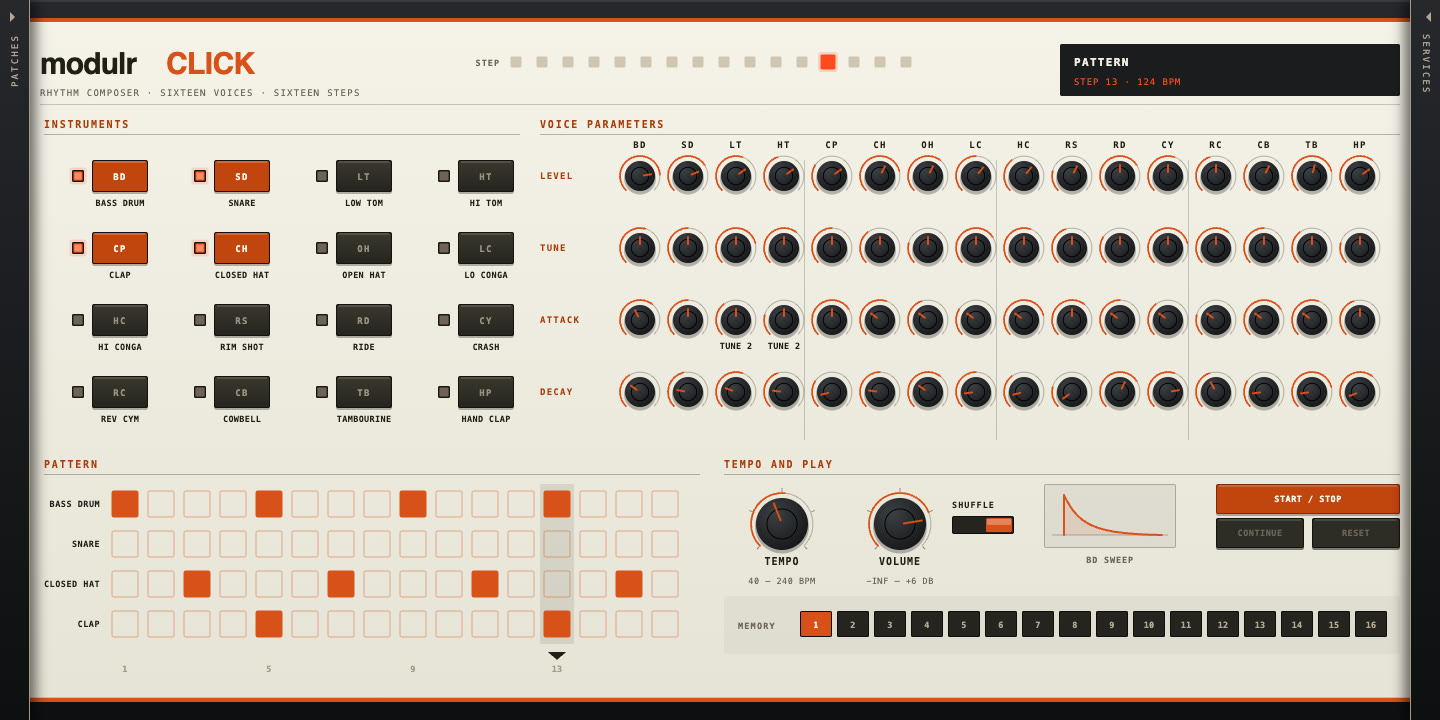
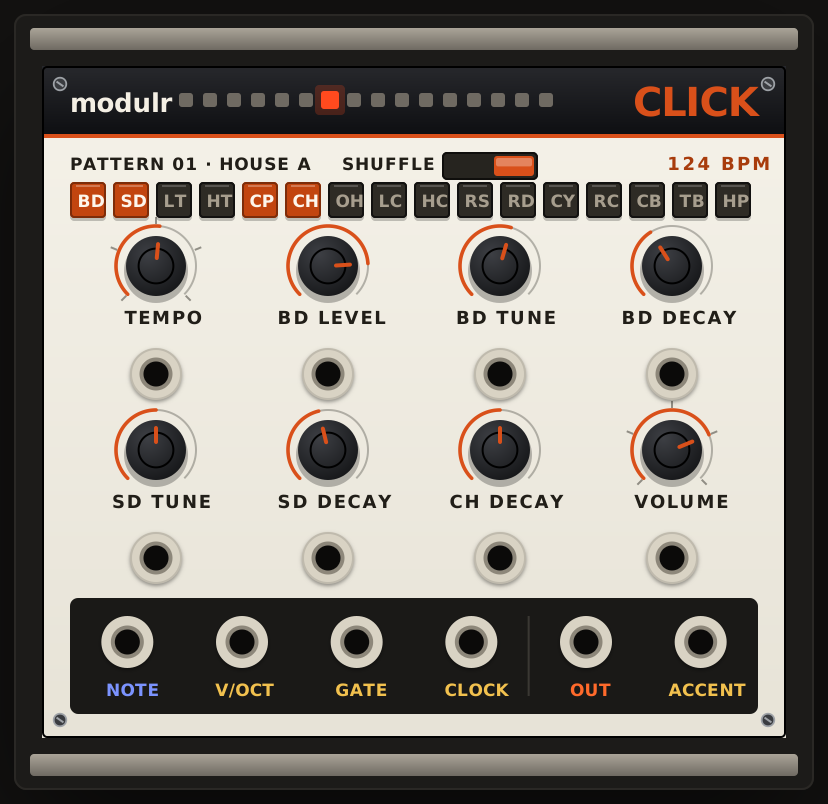
The editor is the plug-in’s own, as it opens. The module is drawn by the specification’s own kit, and its values are illustrative, not measured. The design is TR-909’s grammar, redrawn in Modulr’s own words, and nothing on it is measured against the instrument.
TR-909, 1983.
The instrument’s own grammar, as the catalogue recalls it: the sections, the controls and the look the study borrows.
The rhythm-composer grammar: a block of sixteen instrument buttons with their lamps, one column of level, tune, attack and decay knobs per voice hung on four rows named once in a gutter, a sixteen-step pattern read off lamps, a shuffle switch, a tempo and a memory of sixteen patterns.
A black case with an orange trim line round a warm white panel: sixteen instrument buttons with small lamps, a wall of tiny black knobs that are printed arcs with orange pointers, and a black jack tray.
- Sixteen instrument buttons, each with its own lamp beside it
- Bass drum, snare, toms, clap, hats, congas, rim shot, ride, crash, reverse cymbal, cowbell, tambourine and hand clap
- A level, a tuning and an attack knob for each voice
- A sixteen-step sequencer with a pattern memory of sixteen banks, a shuffle switch and a tempo knob
- A decay knob for the bass drum and the snare
- A pair of tuning knobs for the toms
- The bass drum sweeps down from its own tone
The module, knob by knob.
The module is a design study and is not built. Its macros are the signature controls a player reaches for, not a generic set; each one has a control jack under it.
| Macro | Key | Range | Default |
|---|---|---|---|
| Tempo | seq.tempo | 40 – 240 BPM | 120 BPM |
| BD Level | bd.level | 0 – 100% | 80% |
| BD Tune | bd.tune | ±12 st | 0 st |
| BD Decay | bd.decay | 20 ms – 2 s | 600 ms |
| SD Tune | sd.tune | ±12 st | 0 st |
| SD Decay | sd.decay | 20 ms – 1 s | 150 ms |
| CH Decay | ch.decay | 10 ms – 2 s | 400 ms |
| Volume | out.vol | -inf – +6 dB | 0.0 dB |
| Side | Jacks |
|---|---|
| In | Note (MIDI), V/Oct (CV), Gate (CV), Clock (CV) |
| Out | Out (Audio), Accent (CV) |
Legendary is the catalogue of the Modulr Synths project: 43 design studies drawn with the specification’s own kit, 33 after the synthesizers of all time and 10 after the drum machines. The makers and years named here are the instrument’s; the names, the layouts and every value are Modulr’s own.