Modulr Pilot
Three oscillators, two filters with a spacing control, and a touch surface with an X and a Y, over forty-two patches that each load the whole sound.
Modulr Pilot is a performance monosynthesizer after the grammar of a 2002 instrument: three oscillators, a mixer, a 24 dB low-pass and a 12 dB high-pass with a spacing control, two envelopes, an LFO and a mod bus, and a touch surface with an X and a Y, with a pitch wheel, a mod wheel and a 44-key keyboard.
Four sounds, played as they ship.
Each clip is the plug-in itself: a patch is picked in the drawer and loaded, then a short phrase is played on it. The forty-two patches ship in four families, and they hold four distinct sounds, one for each clip here. The artist-named patches are this product’s reading of a sound’s role on the record named, not the artist’s own.
One voice, three oscillators, and a pad under your hand.
- Three oscillators.Each with an octave, a waveform and a tune, the second and third with a hard sync to the first, and each able to follow the keyboard or hold a fixed pitch.
- A mixer with noise.A level and a switch for each oscillator and the noise.
- Two filters.A 24 dB low-pass and a 12 dB high-pass, with a spacing control between them, a cutoff, an emphasis, an envelope contour and keyboard tracking.
- Two envelopes and an LFO.One envelope for the filter and one for the loudness, and a low-frequency oscillator with five waves, routed to pitch, filter or pulse width by the mod bus.
- A touch surface.Drag the puck: X and Y move the amounts you have routed, and the pad, the wheels and the LFO share one bus.
- Glide, legato and a bender.Portamento over a time you set, a legato key that moves the voice without striking the envelopes again, and a pitch wheel with a range you choose.
- Patches that load the whole sound.Pick a patch and every control moves to it at once; the drawer closes and the keys are ready. Hold to preview plays a patch’s tone on your own MIDI, and when you let go the instrument is exactly as it was.
- Services.Choose whether the instrument answers your host’s MIDI and clock, set its output level, and age it.
What it needs.
| Format | Systems | Licence |
|---|---|---|
| VST3 · Audio Unit | macOS 11 or later, on Apple silicon | A licence is needed to make sound. Without one the editor opens and the output is silent. |
The editor, and the module it becomes.
The plug-in is built. The Eurorack module is drawn, with its macro knobs and the control jacks under them, and is not.
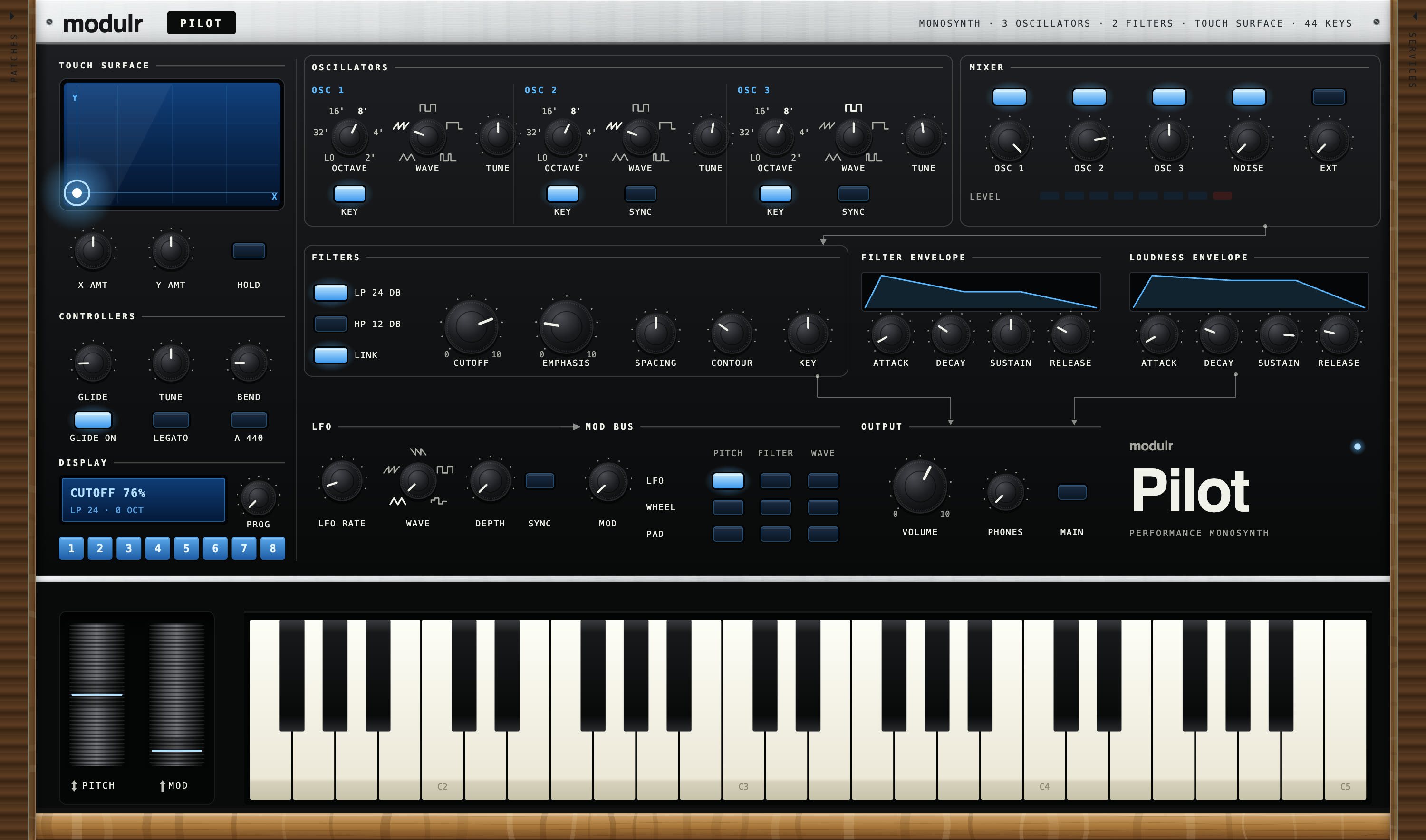
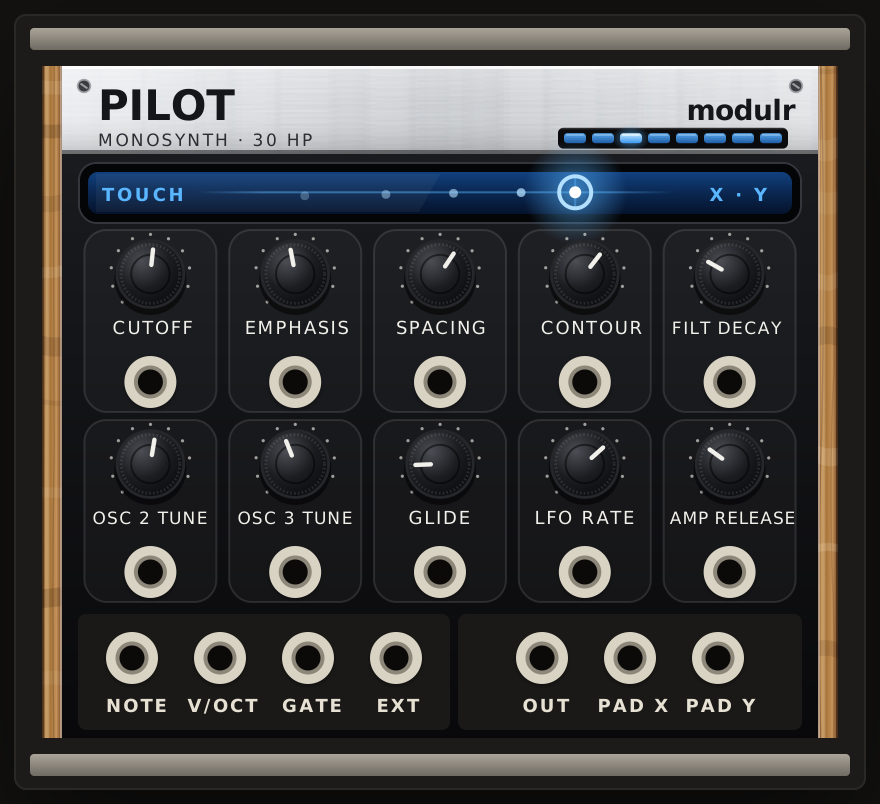
The editor is the plug-in’s own, as it opens. The module is drawn by the specification’s own kit, and its values are illustrative, not measured. The design is Voyager’s grammar, redrawn in Modulr’s own words, and nothing on it is measured against the instrument.
Voyager, 2002.
The instrument’s own grammar, as the catalogue recalls it: the sections, the controls and the look the study borrows.
The performance monosynth grammar: three oscillators with octave, waveform and tune, a mixer, a 24 dB low-pass and a 12 dB high-pass with a spacing control, two envelopes, an LFO and a mod bus, a touch surface with X and Y, eight preset buttons and a display.
A black panel with white lettering under a brushed aluminium header that carries a bank of eight blue-lit preset capsules, between two honey-maple cheeks: a blue glass touch strip, ten black knobs with dotted white scales and a CV jack under each, and the jacks in dark trays at the foot.
- Three oscillators, each with an octave, a waveform, a tune and a mix
- The mixer, with noise and an external input
- A 24 dB ladder low-pass and a 12 dB high-pass, with a spacing control, cutoff and resonance
- Two envelopes, filter and loudness, and the amp
- The mod busses: an LFO with a wave switch, and the mod wheel
- The touch surface controller, with an X and a Y pad
- A bank of eight presets and a display
- The left-hand wheels and a 44-key keyboard
The module, knob by knob.
The module is a design study and is not built. Its macros are the signature controls a player reaches for, not a generic set; each one has a control jack under it.
| Macro | Key | Range | Default |
|---|---|---|---|
| Cutoff | vcf.cut | 20 Hz – 20 kHz | 20 kHz |
| Emphasis | vcf.res | 0–100% | 0% |
| Spacing | vcf.space | ±4 oct | 0 oct |
| Contour | vcf.env | 0–100% | 0% |
| Filt Decay | fenv.decay | 0 ms – 20 s | 200 ms |
| Osc 2 Tune | osc2.tune | ±100 ct | 0 ct |
| Osc 3 Tune | osc3.tune | ±100 ct | 0 ct |
| Glide | osc.glide | 0 ms – 20 s | 0 ms |
| LFO Rate | lfo.rate | 0.05 Hz – 50 Hz | 5 Hz |
| Amp Release | aenv.release | 0 ms – 20 s | 200 ms |
| Side | Jacks |
|---|---|
| In | Note (MIDI), V/Oct (CV), Gate (CV), Ext (Audio) |
| Out | Out (Audio), Pad X (CV), Pad Y (CV) |
Legendary is the catalogue of the Modulr Synths project: 43 design studies drawn with the specification’s own kit, 33 after the synthesizers of all time and 10 after the drum machines. The makers and years named here are the instrument’s; the names, the layouts and every value are Modulr’s own.