Modulr Chorus
One oscillator with a sub and noise, a slider filter, and two chorus stages over fifty patches that each load the whole sound.
Modulr Chorus is a six-voice polyphonic synthesizer after the grammar of a 1984 analogue polysynth. One oscillator with a ramp, a pulse with its own width fader, a sub-oscillator and noise, a four-step high-pass, a resonant low-pass with an envelope in either polarity, an LFO to the pitch and to the filter, an ADSR and a two-mode chorus, every control a fader. Fifty patches, each loading the whole sound at once.
Six patches, played as they ship.
Each clip is the plug-in itself: the patch is picked in the drawer and loaded, a short phrase is played on it, and the cutoff is swept over the take. Each patch is named for a record it is after; its settings are Modulr’s reading of the sound’s role, not the artist’s own. The sound is the instrument’s own output, with no effects and no mastering.
A polysynth you load, then play.
- Patches that load the whole sound.Pick a patch and every control moves to it at once, and the display names it; the drawer closes and the keys are ready.
- Hold to preview.Hold a key to hear a patch’s tone on your own MIDI, then let go and the instrument is exactly as it was.
- Four sources, one filter.A ramp, a pulse with a width fader, a sub-oscillator and noise, then a four-step high-pass and a resonant low-pass whose envelope can open or close it.
- One LFO, two places.The LFO reaches the pitch by up to 400 cents and the cutoff by up to three and a half octaves, each with its own fader, after a delay you set or restarted at each key.
- Two chorus modes.The chorus has two buttons, I and II, which can be used alone or together.
- Services.Choose whether the instrument answers your host’s MIDI and clock, set its output level, and age it: the decay shortens, the tuning drifts flat and the resonance rings less.
What it needs.
| Format | Systems | Licence |
|---|---|---|
| VST3 · Audio Unit | macOS 11 or later, on Apple silicon | A licence is needed to make sound. Without one the editor opens and the output is silent. |
The editor, and the module it becomes.
The plug-in is built. The Eurorack module is drawn, with its macro knobs and the control jacks under them, and is not.
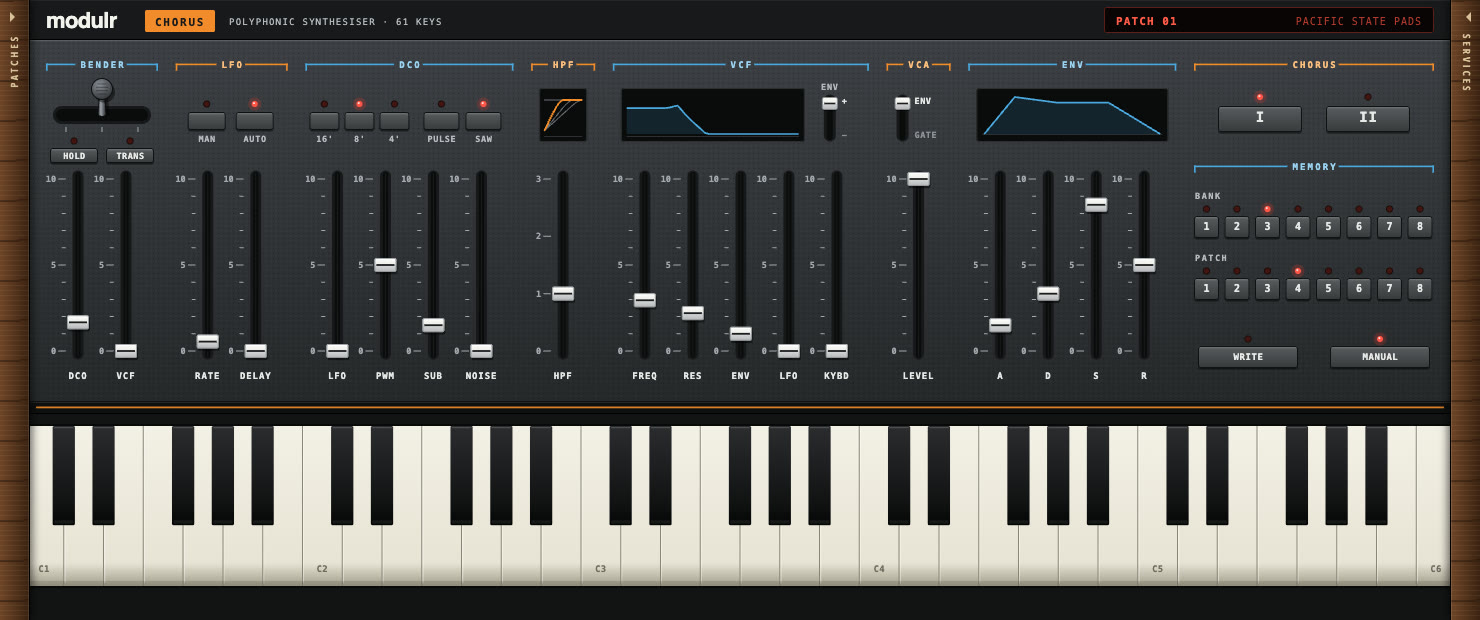
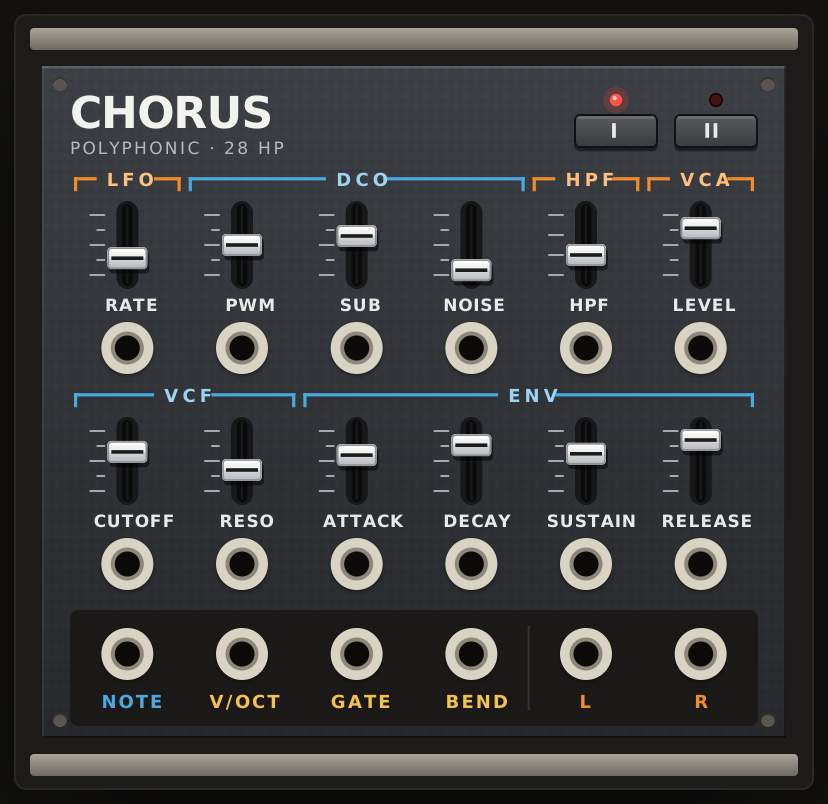
The editor is the plug-in’s own, as it opens. The module is drawn by the specification’s own kit, and its values are illustrative, not measured. The design is Juno-106’s grammar, redrawn in Modulr’s own words, and nothing on it is measured against the instrument.
Juno-106, 1984.
The instrument’s own grammar, as the catalogue recalls it: the sections, the controls and the look the study borrows.
The six-voice analogue polysynth grammar: a bender, an LFO, one DCO with a sub and noise, a four-step high-pass, a resonant low-pass, an ADSR and a stereo chorus I and II, every control a fader.
A dark charcoal panel with printed section titles in blue and orange over rule lines, long white-capped faders against a printed scale, grey rubber buttons with red LEDs, and a stereo pair of outputs.
- Bender lever with bend and LFO amounts
- LFO with rate and delay
- DCO with range, pulse, saw and sub switches, pulse width, PWM and noise level
- Four-step high-pass slider and the VCF: cutoff, resonance, envelope amount, LFO, key follow
- VCA with envelope or gate and a level, and the ADSR
- Chorus I and II buttons with the stereo chorus
- Eight banks of eight patches on numbered buttons, with write and manual
- 61-key keyboard
The module, knob by knob.
The module is a design study and is not built. Its macros are the signature controls a player reaches for, not a generic set; each one has a control jack under it.
| Macro | Key | Range | Default |
|---|---|---|---|
| Rate | lfo.rate | 0.1 – 30 Hz | 5 Hz |
| PWM | dco.pwm | 0–100% | 50% |
| Sub | dco.sub | 0–100% | 0% |
| Noise | dco.noise | 0–100% | 0% |
| HPF | hpf.cut | step 0–3 | step 0 |
| Level | vca.level | 0–100% | 75% |
| Cutoff | vcf.cut | 20 Hz – 20 kHz | 20 kHz |
| Reso | vcf.res | 0–100% | 0% |
| Attack | env.attack | 1 ms – 3 s | 2 ms |
| Decay | env.decay | 1 ms – 3 s | 300 ms |
| Sustain | env.sustain | 0–100% | 70% |
| Release | env.release | 1 ms – 3 s | 200 ms |
| Side | Jacks |
|---|---|
| In | Note (MIDI), V/Oct (CV), Gate (CV), Bend (CV) |
| Out | L (Audio), R (Audio) |
Legendary is the catalogue of the Modulr Synths project: 43 design studies drawn with the specification’s own kit, 33 after the synthesizers of all time and 10 after the drum machines. The makers and years named here are the instrument’s; the names, the layouts and every value are Modulr’s own.