Modulr Scream
Two oscillators, a high-pass and a low-pass filter each with a peak that screams, and a patch panel you can patch.
Modulr Scream is a semi-modular synthesizer after the grammar of a 1978 two-filter instrument: two oscillators with ring mod and sync, a high-pass and a low-pass filter each with a peak, two envelope generators, a modulation generator, an external signal processor and a patch panel of mini jacks with seven cords patched as drawn. Click two jacks to patch them, double-click to unplug. As drawn, oscillator 1 reaches the filter alone, so oscillator 2 and the mixer are heard once that cord is unplugged.
Six sounds, played as they ship.
Each clip is the plug-in itself: a patch is picked in the drawer and loaded, then a played chord or line sounds on it, the way it is played into the plug-in from a keyboard. The fifty-six patches hold six distinct sounds, and these are those six. No effects, no mastering.
Two filters, a patch panel and a screaming Peak.
- Two oscillators.Each a triangle, a saw, a pulse or noise; the first with pulse width and its modulation, the second with a ring mod and a hard sync, both with modulation from the modulation generator and the first envelope.
- Two filters.A high-pass and a low-pass, each with a cutoff and a Peak that rings, the low-pass up to self-oscillation, with keyboard tracking, an envelope amount and modulation from the modulation generator.
- Two envelopes and a modulation generator.The first envelope has a delay, an attack and a release; the second an attack, a hold, a decay, a sustain and a release; the modulation generator a rate and four waveforms.
- A patch panel.Thirty mini jacks with seven cords patched as drawn: click two jacks to patch them, double-click to unplug. Because oscillator 1 is cabled straight to the filter input, oscillator 2 and the mixer are heard once that cord is out.
- An external signal processor.A band-pass, an envelope follower, a gate and a frequency-to-voltage converter, working on whatever is patched to its input; with nothing patched its outputs read zero.
- Patches that load the whole sound.Pick a patch and every control moves to it at once; the drawer closes and the keys are ready. Hold to preview plays a patch’s tone on your own MIDI, and when you let go the instrument returns to what it was. The fifty-six patches hold six distinct sounds.
- Services.Choose whether the instrument answers your host’s MIDI and clock, set its output level, and age it.
What it needs.
| Format | Systems | Licence |
|---|---|---|
| VST3 · Audio Unit | macOS 11 or later, on Apple silicon | A licence is needed to make sound. Without one the editor opens and the output is silent. |
The editor, and the module it becomes.
The plug-in is built. The Eurorack module is drawn, with its macro knobs and the control jacks under them, and is not.
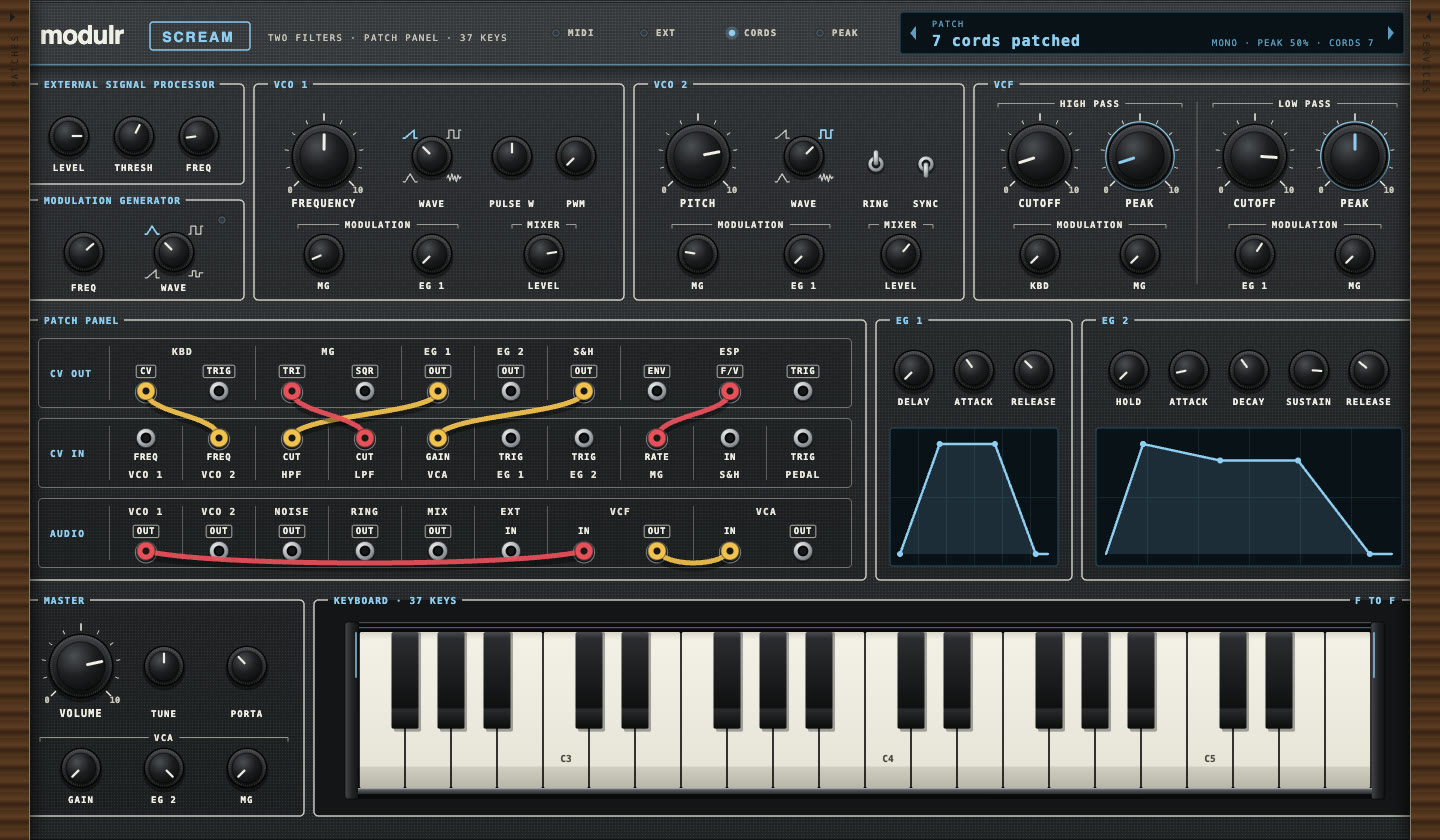
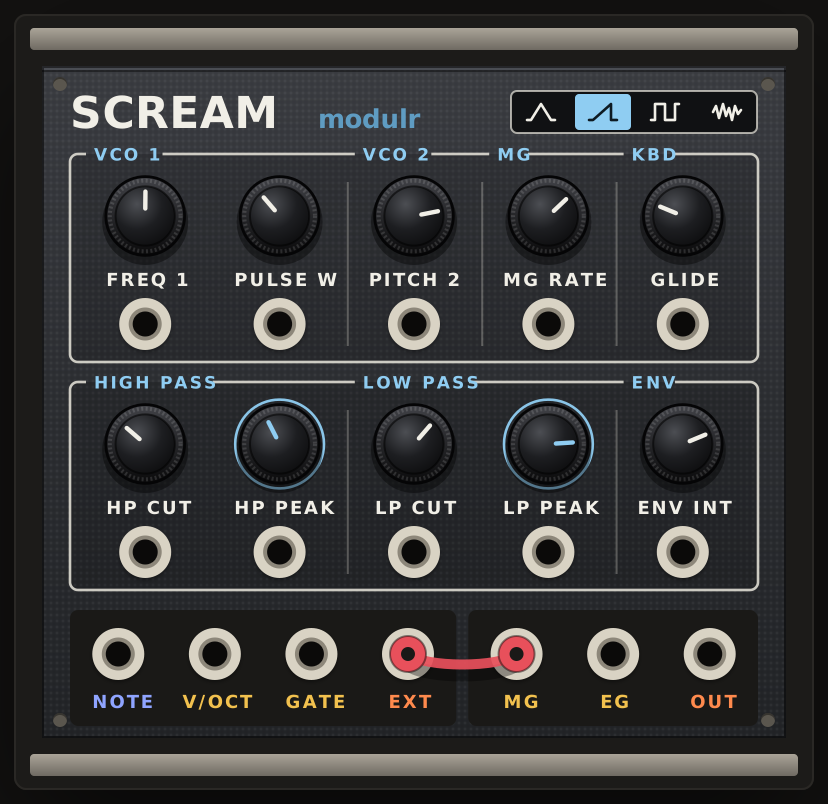
The editor is the plug-in’s own, as it opens. The module is drawn by the specification’s own kit, and its values are illustrative, not measured. The design is the MS-20’s grammar, redrawn in Modulr’s own words, and nothing on it is measured against the instrument.
MS-20, 1978.
The instrument’s own grammar, as the catalogue recalls it: the sections, the controls and the look the study borrows.
The two-filter semi-modular grammar: two oscillators with waveform symbols round rotary switches, ring mod and sync, a high-pass and a low-pass filter each with a screaming Peak, two envelope generators, a modulation generator, an external signal processor, a patch panel of mini jacks with red and yellow cords and a 37-key mini keyboard.
A dark charcoal panel printed with white boxes and sky-blue headings, black knobs with a white line, the two Peak knobs ringed and pointed in sky blue, a waveform glyph switch under the title, ten macros in two framed rows, two even dark jack trays and a red patch cord at the foot.
- Two VCOs: frequency, waveform, pulse width, ring mod and sync
- High-pass and low-pass filters, each with cutoff and resonance
- Two envelope generators, the first with delay, attack, hold, decay, sustain and release, the second an attack and release
- Modulation generator: frequency and waveform
- External signal processor with a frequency-to-voltage converter
- Patch panel of mini jacks with coloured patch cords
- 37-key mini keyboard
The module, knob by knob.
The module is a design study and is not built. Its macros are the signature controls a player reaches for, not a generic set; each one has a control jack under it.
| Macro | Key | Range | Default |
|---|---|---|---|
| Freq 1 | vco1.freq | 16 Hz – 4.2 kHz | 262 Hz |
| Pulse W | vco1.pw | 5–95% | 50% |
| Pitch 2 | vco2.pitch | ±12 st | 0 st |
| MG Rate | mg.rate | 0.05 – 50 Hz | 4 Hz |
| Glide | kbd.porta | 0 ms – 2 s | 0 ms |
| HP Cut | hpf.cut | 20 Hz – 20 kHz | 20 Hz |
| HP Peak | hpf.peak | 0–100% | 0% |
| LP Cut | lpf.cut | 20 Hz – 20 kHz | 20 kHz |
| LP Peak | lpf.peak | 0–100% | 0% |
| Env Int | vcf.egint | ±100% | 0% |
| Side | Jacks |
|---|---|
| In | Note (MIDI), V/Oct (CV), Gate (CV), Ext (Audio) |
| Out | MG (CV), EG (CV), Out (Audio) |
Legendary is the catalogue of the Modulr Synths project: 43 design studies drawn with the specification’s own kit, 33 after the synthesizers of all time and 10 after the drum machines. The makers and years named here are the instrument’s; the names, the layouts and every value are Modulr’s own.