Modulr Pocket
Four encoders in four colours and one small screen, drawn over a single synth voice with nine patches.
Modulr Pocket is a synthesizer after the grammar of the OP-1 of 2011: one small screen, four colour-coded encoders, mode keys for synth, drum, tape and mixer, transport keys, and a small keyboard in the same body. As a plug-in it plays one synth voice from your MIDI: four of the eight drawn knobs reach it, and the screen, the mode keys, the tape and the effect are drawn, not built.
Nine sounds, played as they ship.
Each clip is the plug-in itself: a patch is picked in the drawer and loaded, then notes are played on it from MIDI. The nine patches hold nine distinct sounds, one for each clip here. The editor does not light its keys or move its screen as the notes play: those are drawn, not live. No manual documents a setting for the OP-1, so every patch is this product’s reading of a role.
One voice, under a drawn pocket studio.
- One oscillator.A wave position that sweeps three shapes, a pulse width, and a tuning of up to seven semitones either way.
- One envelope.A gate pulse that stands in for the attack, a decay of up to two and a half seconds, and an accent.
- Four knobs that work.The blue encoder sets the wave position, the white one the decay, the tempo knob the sequencer’s tempo, and the volume knob the level. The green, orange, tape-speed and effect knobs are drawn and do nothing.
- What is drawn and not built.The screen, the mode keys for synth, drum, tape and mixer, the function keys and the on-screen keyboard are drawn and inert. There is no filter, no sampler, no tape recorder and no effects. Play your own MIDI keyboard.
- Patches that load the whole sound.Pick a patch and every control moves to it at once; the drawer closes. Hold to preview plays a patch’s tone on your own MIDI, and when you let go the instrument is exactly as it was.
- Services.Choose whether the instrument answers your host’s MIDI and clock, set its output level, and age it.
What it needs.
| Format | Systems | Licence |
|---|---|---|
| VST3 · Audio Unit | macOS 11 or later, on Apple silicon | A licence is needed to make sound. Without one the editor opens and the output is silent. |
The editor, and the module it becomes.
The plug-in is built. The Eurorack module is drawn, with its macro knobs and the control jacks under them, and is not.
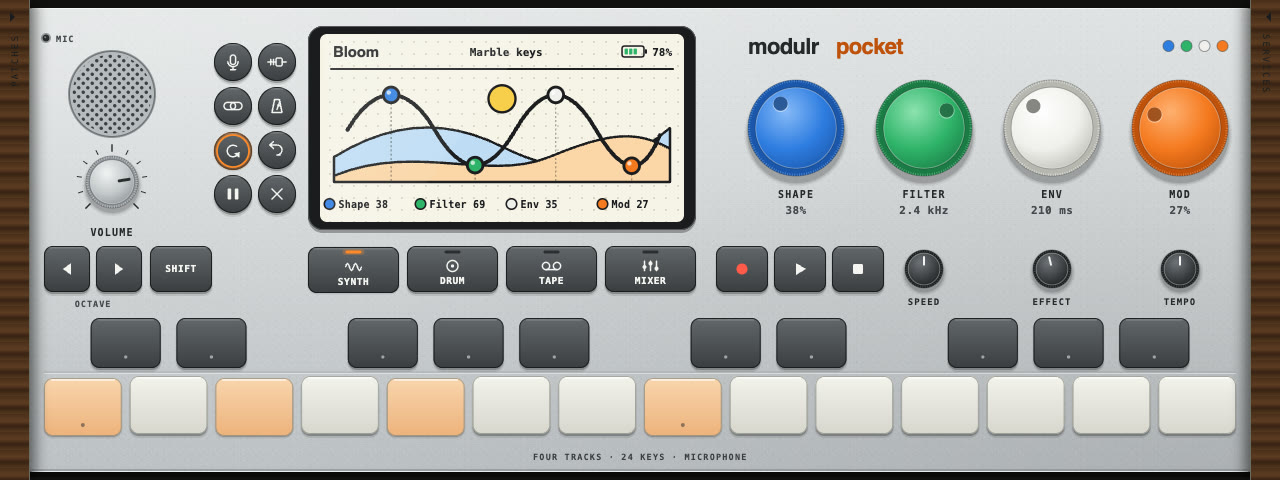
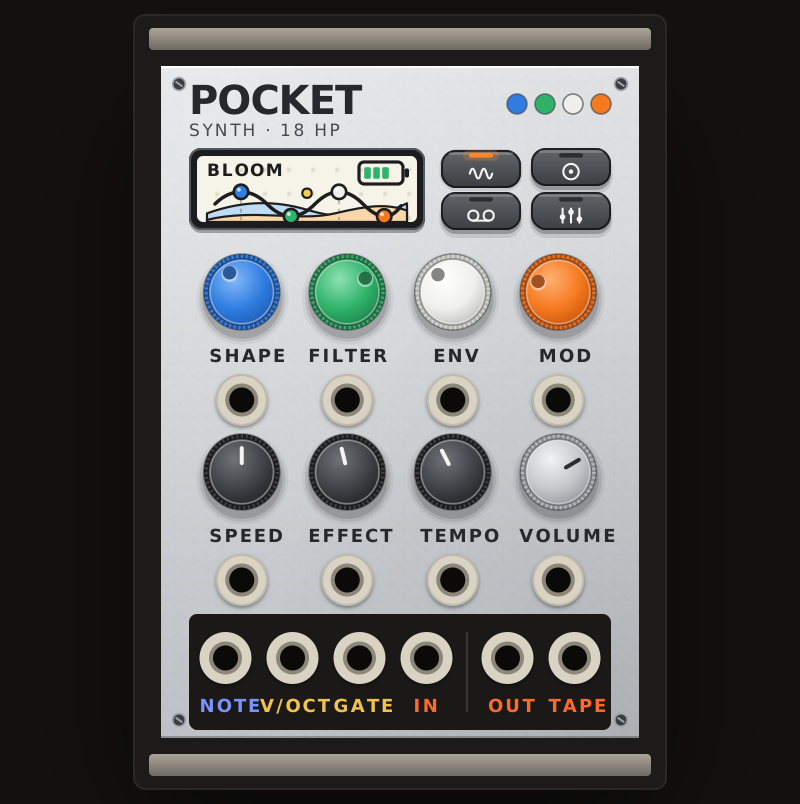
The editor is the plug-in’s own, as it opens; the numbers on its screen and under its inert knobs are drawn, and do not follow any control. The module is drawn by the specification’s own kit, and its values are illustrative, not measured. The design is the OP-1’s grammar, redrawn in Modulr’s own words, and nothing on it is measured against the instrument.
OP-1, 2011.
The instrument’s own grammar, as the catalogue recalls it: the sections, the controls and the look the study borrows.
The pocket-studio grammar: a small friendly screen, four colour-coded endless encoders that mean something different in every mode, round glyph keys, icon mode keys for synth, drum, tape and mixer, and squarish rubber keys in two staggered rows.
A pale bead-blasted aluminium slab in 18 HP: a bright mini screen with a cartoon wave and four coloured dots beside four tiny icon mode keys, four anodised encoders (blue, green, white, orange) and four graphite knobs, each with a CV jack, and an evenly spaced dark jack tray at the foot.
- A small colour screen: the synth engine, an effect, or the tape
- Four colour-coded encoders: blue, green, white and orange
- Mode buttons for synth, drum, tape and mixer
- A row of function buttons and the transport keys
- A pair of small rubber keys and a small keyboard
- A microphone, a speaker, one volume knob and a battery
The module, knob by knob.
The module is a design study and is not built. Its macros are the signature controls a player reaches for, not a generic set; each one has a control jack under it.
| Macro | Key | Range | Default |
|---|---|---|---|
| Shape | osc.shape | 0–100% | 50% |
| Filter | vcf.cut | 20 Hz – 20 kHz | 20 kHz |
| Env | env.time | 2 ms – 4 s | 120 ms |
| Mod | mod.amt | 0–100% | 0% |
| Speed | tape.speed | ±12 st | 0 st |
| Effect | fx.amt | 0–100% | 0% |
| Tempo | seq.tempo | 40–240 BPM | 120 BPM |
| Volume | out.vol | -inf – +6 dB | 0.0 dB |
| Side | Jacks |
|---|---|
| In | Note (MIDI), V/Oct (CV), Gate (CV), In (Audio) |
| Out | Out (Audio), Tape (Audio) |
Legendary is the catalogue of the Modulr Synths project: 43 design studies drawn with the specification’s own kit, 33 after the synthesizers of all time and 10 after the drum machines. The makers and years named here are the instrument’s; the names, the layouts and every value are Modulr’s own.