Modulr Sextet
Six voices of two oscillators with a shape and a hard sync, a sub, a resonant low-pass and high-pass, poly mod, one effect, an arpeggiator and a sequencer.
Modulr Sextet is a six-voice polyphonic synthesizer after the grammar of a 2015 programmable instrument: two oscillators and a sub, a mixer with noise and a ring product, a four-pole low-pass and a two-pole high-pass, poly mod from the filter envelope and the second oscillator, two ADSR envelopes, an LFO and one effect from five. Built as a VST3 and Audio Unit, and drawn as a 28 HP module.
Seven sounds, played as they ship.
Each clip is the plug-in itself: a patch is picked in the drawer and loaded, then a played chord or line sounds on it, the way it is played into the plug-in from a keyboard. The bank holds seven patches and seven distinct sounds, and these are those seven. No effects, no mastering.
Six voices, two oscillators each, two filters.
- Two oscillators a voice.Each a sawtooth bent towards a triangle by its shape, a triangle and a pulse of a set width, every wave switched in by its own cap; the second hard-syncs the first, and the slop wanders them apart.
- A mixer with a sub and a ring.The two oscillators, a sub-octave square and white noise; the ring puts the product of the two oscillators in the second one’s place, and the drive pushes the sum into the filters.
- Two filters.A resonant four-pole (or two-pole) low-pass and a resonant two-pole high-pass, each opened by the filter envelope, the key and the LFO.
- Poly mod.Each voice’s own filter envelope and second oscillator move the first oscillator’s pitch, shape and the cutoffs, by the destinations you switch on.
- Two envelopes, an LFO and the wheels.An attack, decay, sustain and release for the filter and for the amplifier, each with a velocity; an LFO of five waves that the mod wheel adds to; a pitch wheel that springs back.
- One effect.Delay, reverb, chorus, phaser or flanger, at a mix, with two parameters and a tempo sync.
- Unison, chord memory, an arpeggiator and a sequencer.Unison stacks all six voices on one key; the chord memory plays a held chord from one key; the arpeggiator walks the held keys over one to three octaves; the sequencer plays sixteen steps of a note, a rest or a tie. The sixteen steps are host parameters; recording from the keys is the bench’s, and the record, rest and tie caps do nothing inside a host.
- Patches that load the whole sound.Pick a patch and every control moves to it at once; the drawer closes and the keys are ready. Hold to preview plays a patch’s tone on your own MIDI, and when you let go the instrument is put back.
- Services.Choose whether the instrument answers your host’s MIDI and clock, set its output level, and age it.
What it needs.
| Format | Systems | Licence |
|---|---|---|
| VST3 · Audio Unit | macOS 11 or later, on Apple silicon | A licence is needed to make sound. Without one the editor opens and the output is silent. |
The editor, and the module it becomes.
The plug-in is built. The Eurorack module drawn beside it, with its eight macro knobs and the control jacks under them, is a design study and is not.
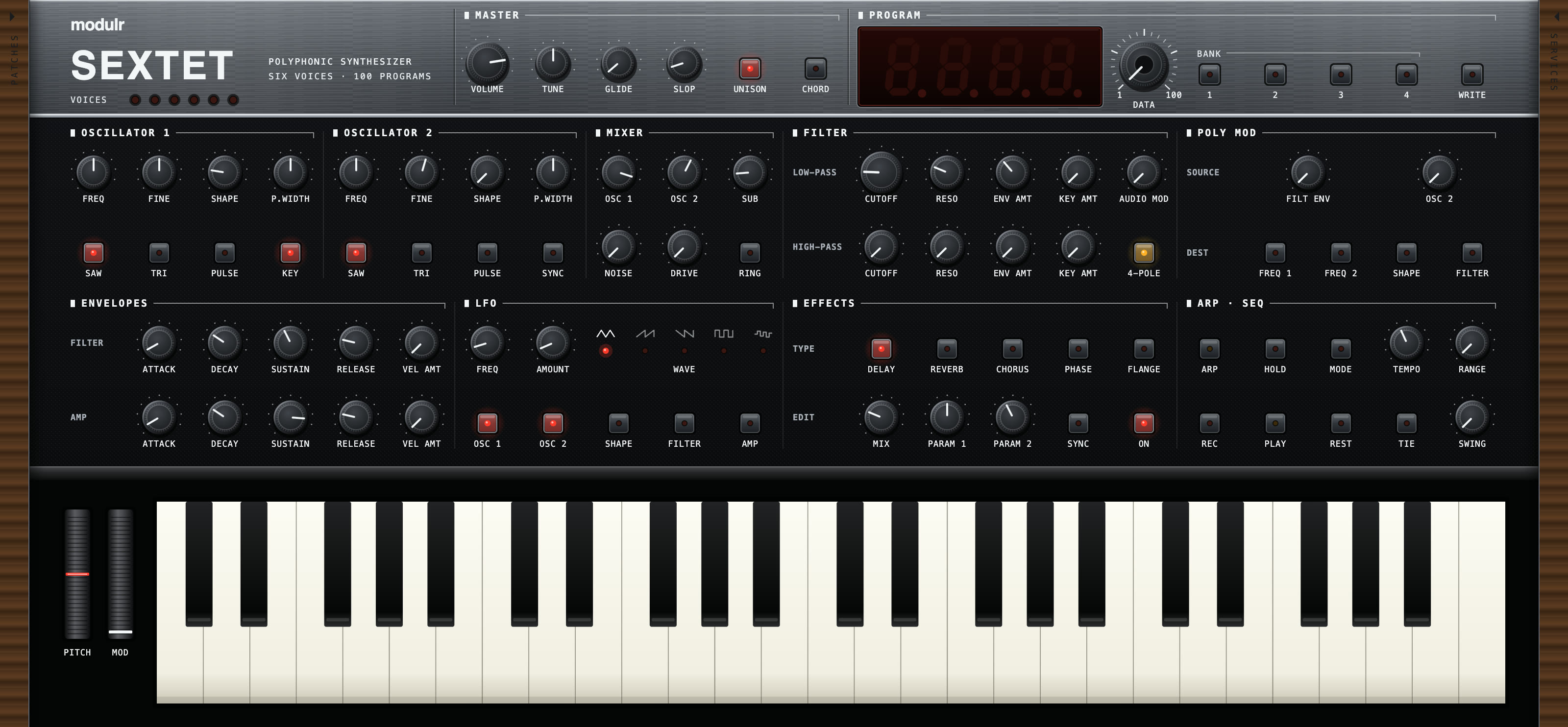
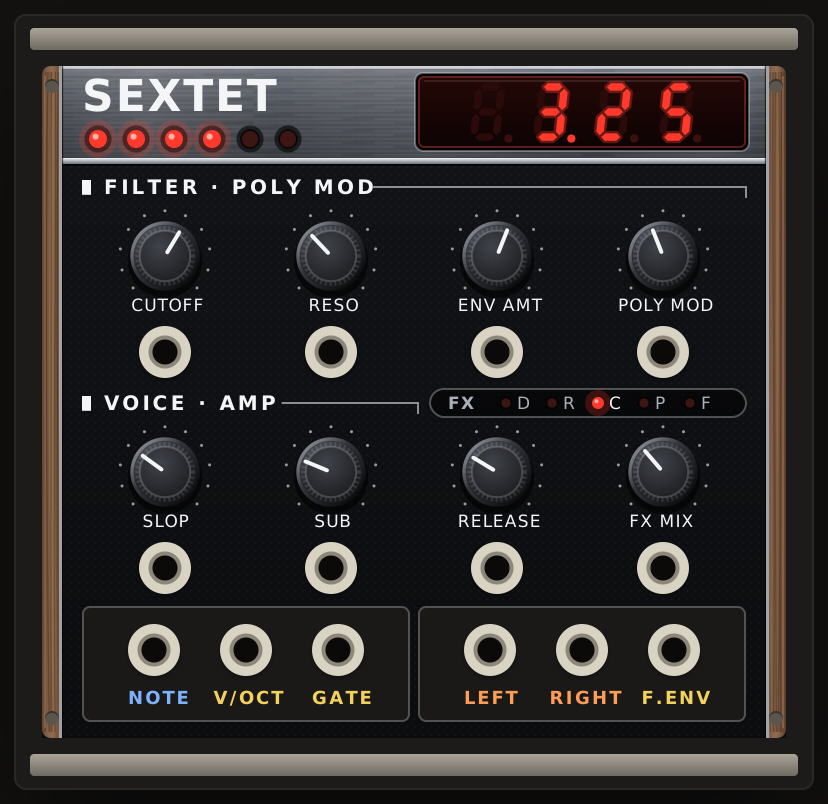
The editor is the plug-in’s own, as it opens. The module is drawn by the specification’s own kit, and its values are illustrative, not measured. The design is the Prophet-6’s grammar, redrawn in Modulr’s own words, and nothing on it is measured against the instrument.
Prophet-6, 2015.
The instrument’s own grammar, as the catalogue recalls it: the sections, the controls and the look the study borrows.
The six-voice programmable polyphonic grammar: two oscillators with a shape select and a sub, a mixer, low-pass and high-pass filters, poly mod, two ADSR envelopes, an LFO with a wave strip, digital effects chosen from five lit types, an arpeggiator and sequencer, and a large program display with a round data knob, banks and write.
A cool black panel in flat modern print under a brushed satin-aluminium head rail: white block markers before every heading, small black knobs ringed with printed dots, square translucent push caps lit red or amber from inside, a large red four-digit program display, and narrow light satin walnut edges.
- Two oscillators and a sub-oscillator with a shape select, and a mixer
- A low-pass and a high-pass filter: cutoff, resonance, envelope amount, key track
- Two ADSR envelopes, one for the filter and one for the amplifier
- An LFO with a wave select and destinations
- Poly mod, taking the filter envelope as a source
- A digital effects section: delay, reverb, chorus, phase, flange
- An arpeggiator and a sequencer
- A four-digit program display with a data knob, banks and write
The module, knob by knob.
The module is a design study and is not built. Its macros are the signature controls a player reaches for; each has a control jack under it.
| Macro | Key | Range | Default |
|---|---|---|---|
| Cutoff | vcf.cut | 20 Hz – 20 kHz | 3.0 kHz |
| Reso | vcf.res | 0–100% | 0% |
| Env Amt | vcf.env | 0–100% | 0% |
| Poly Mod | pmod.fenv | 0–100% | 0% |
| Slop | master.slop | 0–100% | 10% |
| Sub | mix.sub | 0–100% | 0% |
| Release | amp.release | 0 ms – 20 s | 200 ms |
| FX Mix | fx.mix | 0–100% | 0% |
| Side | Jacks |
|---|---|
| In | Note (MIDI), V/Oct (CV), Gate (CV) |
| Out | Left (Audio), Right (Audio), F.Env (CV) |
Legendary is the catalogue of the Modulr Synths project: 43 design studies drawn with the specification’s own kit, 33 after the synthesizers of all time and 10 after the drum machines. The makers and years named here are the instrument’s; the names, the layouts and every value are Modulr’s own.